
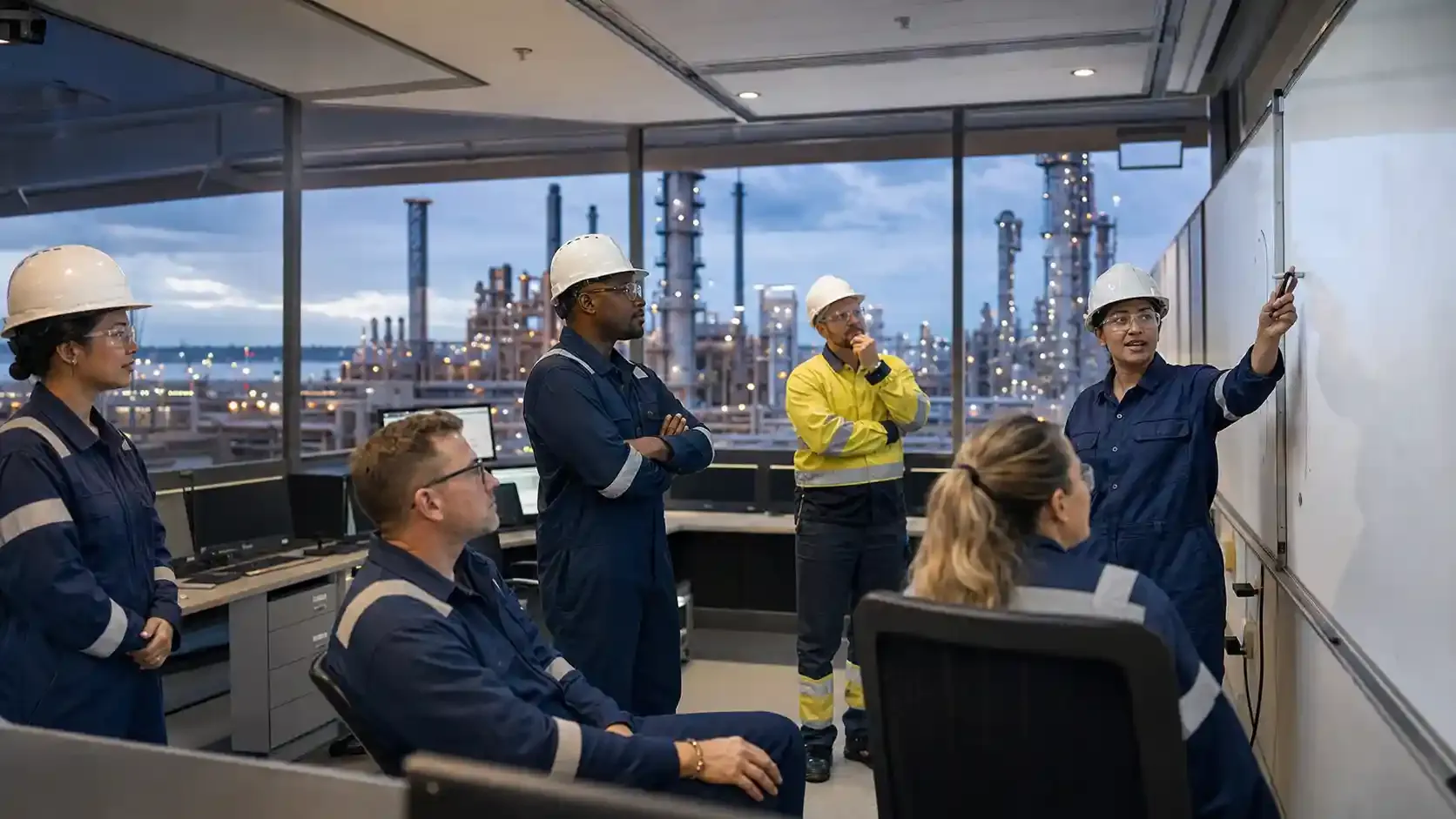
Build practical conditions that allow women to enter, contribute and lead in high-hazard work. Focus on access, respectful challenge, fair development and accountable follow-through.
Process-safety decisions depend on people who can share relevant evidence, question assumptions and report concerns. Leaders can support that work by making technical participation fair, respectful and safe for everyone, including women who work in engineering and operations.
This article does not claim that women are inherently safer leaders or that gender diversity alone prevents incidents. It focuses on workplace conditions and practical leadership actions. The Department of Science, Technology and Innovation’s 2026 South African Women in Science Awards recognized women across engineering and other fields and described role models as part of its purpose.
Make participation part of risk reviews
South African MHI regulation 10 requires consultation with the relevant health and safety representative or committee when arranging the AIA risk assessment. In workshops and operating reviews, leaders can make participation meaningful by inviting evidence from people closest to the work, recording unresolved concerns and explaining how decisions were reached.
Use structured speaking turns, ask for alternative explanations before accepting a conclusion and give junior employees a clear route to raise a concern. Do not treat respectful challenge as resistance to production.
Remove practical barriers to technical work
Review whether PPE, field tools, welfare facilities, transport, shift arrangements and access to training fit the people expected to use them. Give employees meaningful exposure to hazard studies, operations, maintenance, incident learning and emergency exercises with competent supervision.
Make technical progression visible. Explain the skills, evidence and experience expected for specialist, facilitator, operations, integrity and leadership roles. Provide mentoring and sponsorship without replacing fair selection criteria or individual competence assessment.
Measure whether policies change work
Track access to technical assignments, training, advancement and workshop roles. Review concerns about harassment, bullying or exclusion through the employer’s established reporting and investigation processes. Protect confidentiality and avoid publishing small-group data that could identify individuals.
Use these measures to find barriers and improve systems. Do not claim that a single headcount or survey score predicts process-safety performance.
Questions about women’s leadership in process safety
Does having more women on a team guarantee better safety decisions?
No. A headcount does not prove how a team makes decisions. Leaders must make sure each person can contribute relevant expertise and challenge weak assumptions.
What can a process-safety leader change now?
Review PPE and field access, invite operational knowledge into risk reviews, set clear routes for concerns, and make development criteria transparent. Follow up on reported barriers through established processes.
Does MHI regulation 10 require consultation with workers?
Regulation 10 requires the duty holder to consult the relevant health and safety representative or committee when arranging the AIA risk assessment. Check the full Regulations for the applicable duties and process.