
AI in HAZOP: What the Facilitator Still Must Own
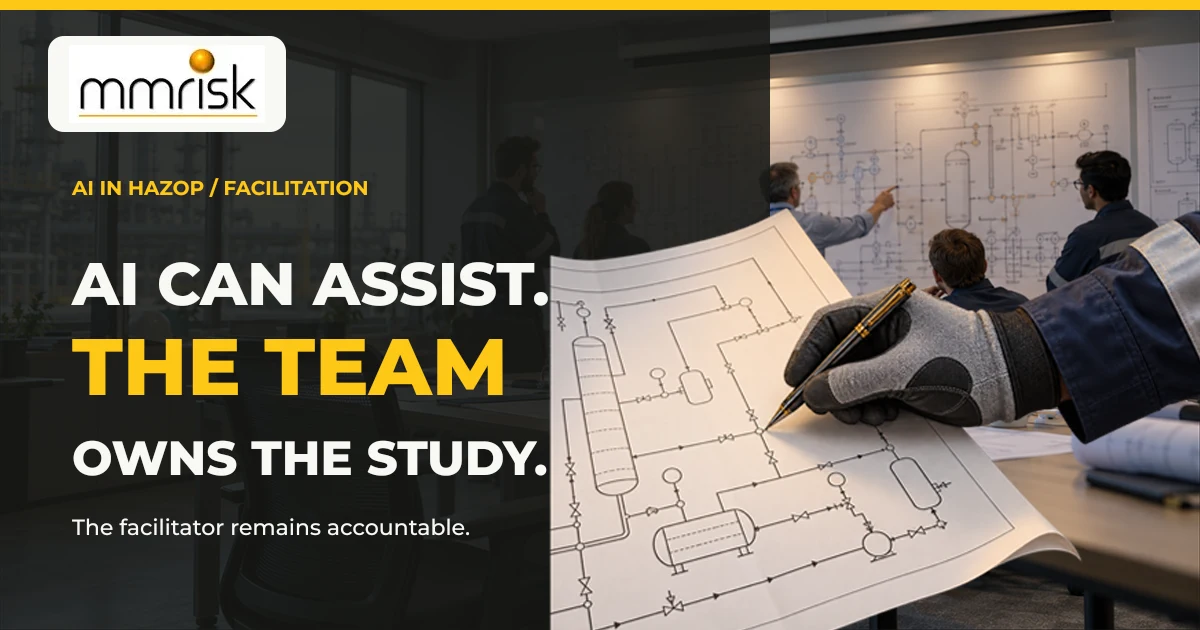
AI can help organise study material, but competent people must verify the process basis, challenge deviations and own the HAZOP decisions.
AI in HAZOP: What the Facilitator Still Must Own
AI can help organise HAZOP preparation, find repeated terms in source documents or turn approved notes into a draft action log. It cannot confirm that a process description is correct, decide whether a safeguard is independent, or accept risk on behalf of a facility. The facilitator and study team remain responsible for the quality of the discussion and its record.
The IEC 61882 application guide describes HAZOP as a structured study method using guide words, with stages for definition, preparation, examination, documentation and follow-up. AI may assist with bounded tasks within those stages, but it should not silently replace the examination process or the engineering judgement behind the record.
Set boundaries before using a tool
Write down the purpose, approved data sources, allowed tasks and reviewer. Do not upload controlled drawings, personal information, security-sensitive plant data or client material to an AI service unless the data owner has approved the service and its handling terms.
Suitable support tasks may include formatting a node list, finding inconsistent tags in a supplied document set, or producing a first-pass summary that a person checks. Treat the output as a draft. Record the model or service used, input version, date, reviewer and any changes made where the output influences study evidence.
Protect the engineering work
- Check the process basis. Confirm design intent, operating conditions, boundaries, materials, drawings and procedures against controlled records.
- Use guide words deliberately. The team must test deviations against actual causes, consequences and safeguards. A generated list can miss context or repeat generic hazards.
- Challenge safeguard claims. Verify that credited safeguards exist, are available, independent where required and maintained. A confident AI description is not proof.
- Keep people in the loop. Include operators, maintenance staff, process engineers and other relevant disciplines who understand how the plant runs.
- Own recommendations. The team must agree on the action, accountable owner, priority, due date and closure evidence. Do not let a tool close an action by rewriting its status.
NIST’s AI Risk Management Framework calls for defined human-AI roles and documented oversight, as well as testing and monitoring through the system lifecycle. It is voluntary, general guidance, not a process safety standard. Apply any AI controls alongside the facility’s own management-of-change, information-security and HAZOP procedures.
AI can reduce administrative effort when the source material is controlled and a competent reviewer checks every safety-relevant output. It cannot turn weak input data into a sound hazard analysis. MMRisk provides HAZOP facilitation and training and a practical HAZOP guide. Contact our team to discuss a facilitated study or training.