
Behaviour-Based Safety and Process Safety: Where Each Method Helps
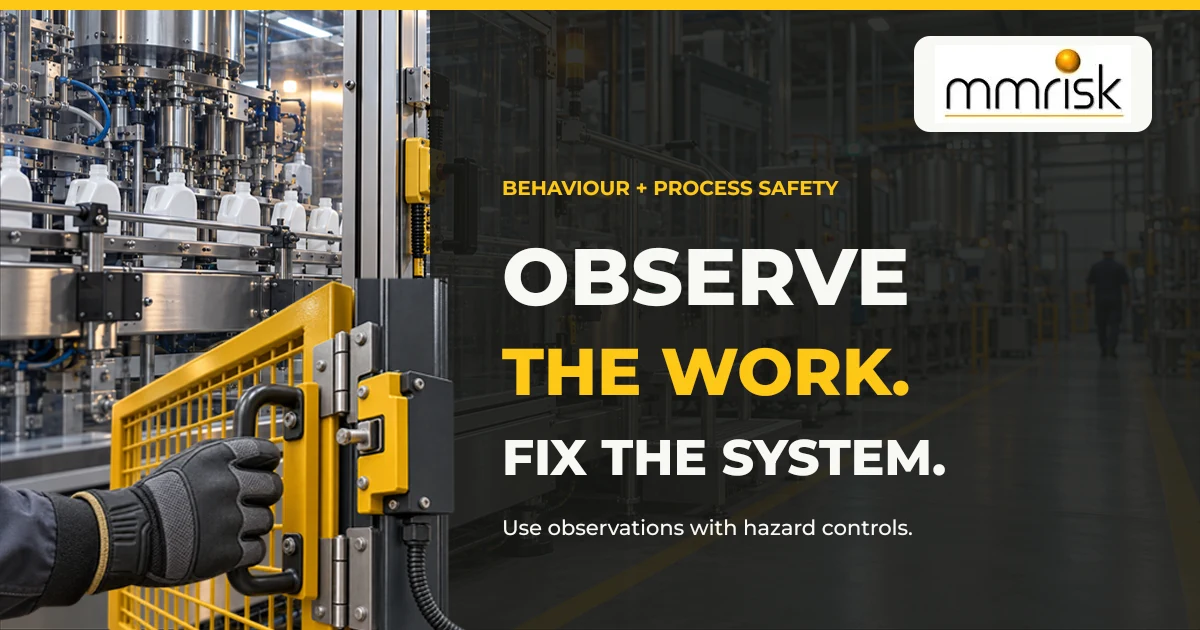
Worker behaviour can shape exposure, but observation programmes cannot replace hazard analysis, engineered safeguards or reliable equipment.
Behaviour-Based Safety and Process Safety: Where Each Method Helps
An observation can identify a risky condition or a task that is harder to perform safely than the written procedure suggests. It cannot show, by itself, that the process is protected against a major release, fire or explosion. Use behaviour-based safety to understand work and improve conditions; use process safety methods to identify and control major-hazard scenarios.
Behaviour programmes often focus on actions people can see: position, communication, use of a tool or adherence to a step. These observations can prompt coaching and reveal weak work design. Process safety looks at hazards that may affect many people or the surrounding community, including loss of containment and failures of critical safeguards. The two approaches can support one another when they address the right level of risk.
Put controls in the right order
The hierarchy of controls prioritises eliminating a hazard, substituting it, and using engineering controls before relying on administrative rules and personal protective equipment. It is a useful design principle: changing a process or isolating people from a hazard usually provides more dependable protection than repeatedly asking workers to compensate for a weak system.
For example, if workers repeatedly bypass a guard or defeat an alarm, do not treat the observation as a behaviour problem until you understand why the safeguard is being bypassed. The equipment may be unreliable, the task may be poorly designed, or the alarm may not distinguish a genuine demand from nuisance signals. Address the design, workload, maintenance and procedure issues as well as the individual action.
Use observations to improve the system
- Define the hazard or task the observation is meant to illuminate.
- Involve workers in choosing what to observe and how findings will be used.
- Record work conditions and constraints, not just a label such as “unsafe act.”
- Keep participation separate from punishment and productivity ranking.
- Escalate findings that affect safety-critical barriers into the risk assessment or management-of-change process.
- Track whether controls changed the work and whether the change reduced exposure.
OSHA’s recommended practices call for worker involvement in hazard controls. OSHA rules apply in the United States; the hierarchy itself is a general risk-control concept and does not replace South African legal duties or site-specific engineering review.
For a major hazard installation, use HAZOP, LOPA, QRA and barrier reviews to test scenarios and safeguards. Behaviour observations can then help confirm whether procedures and controls work in real operating conditions. Explore MMRisk’s HAZOP and risk assessment services and HAZOP guidance. Talk with MMRisk about linking field observations to a process safety improvement plan.