
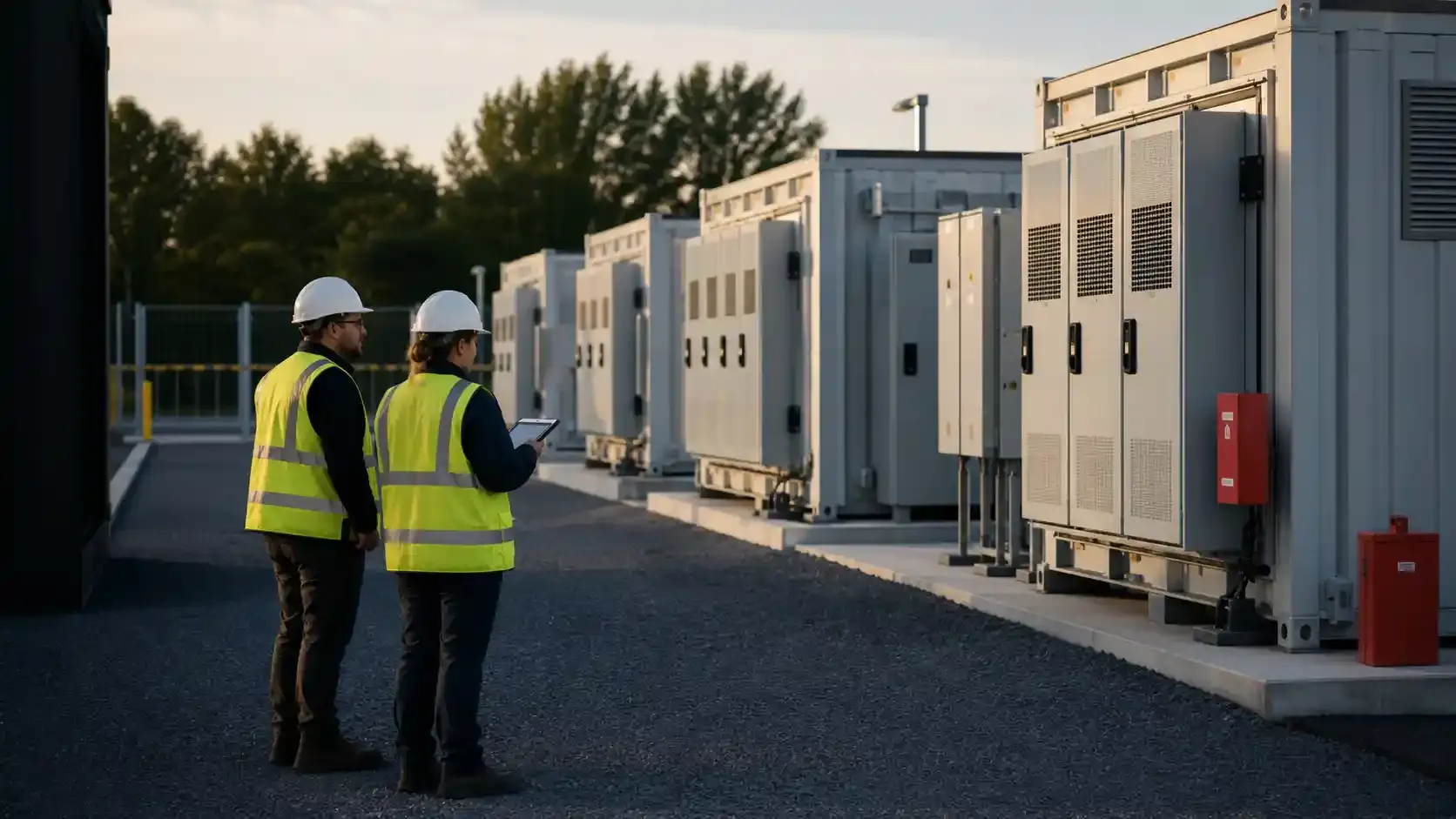
Assess battery energy storage system hazards against chemistry, design, layout, emergency response and nearby receptors.
Updated: 3 November 2026. This revision qualifies chemistry-dependent hazards, adds current test-method context and separates international guidance from South African legal requirements.
Updated: 3 November 2026. This revision qualifies chemistry-dependent hazards, adds current test-method context and separates international guidance from South African legal requirements.
Battery energy storage system (BESS) hazards depend on the chemistry, product design, installation, operating conditions and site. Lithium-ion thermal runaway can release heat and gases, propagate between cells or units, and create fire, explosion or responder exposure hazards. Those outcomes are not identical for every battery technology or installation, so assess the actual system and credible event scenarios.
Start with the credible event sequence
For a lithium-ion BESS, thermal runaway may begin within a cell and propagate depending on design and conditions. Ask how a credible fault could develop, what hazards could follow and which controls limit the consequences. Testing and incident research can inform that assessment but cannot replace site-specific analysis.
Review detection, ventilation, enclosure design, spacing, potential fire spread, ignition sources, emergency access, runoff, communications and effects on nearby people or assets. Discuss the emergency strategy with the relevant fire and emergency services during design. The appropriate measures depend on the installation and the authority having jurisdiction.
Use HAZOP thinking for BESS
Apply the same disciplined questions used in conventional process safety. What if cooling is lost? What if a sensor fails low? What if ventilation does not start? What if a container door is opened after gas has accumulated? What if one unit is isolated but heat affects the next?
A HAZOP or another suitable hazard review may be used where it fits the project and study basis. Select participants for the actual scope, which may include the integrator, electrical engineer, operator, maintainer, fire specialist and emergency planner. Consider normal operation, commissioning, maintenance, fault recovery and decommissioning where those activities are in scope.
Design multiple, testable barriers
No single device establishes BESS safety. Controls are site-specific and may include cell and system design, detection, alarm logic, thermal management, ventilation, isolation, separation, fire protection or exposure protection, access control and responder information. Verify each control against the design basis and applicable requirements. A UL 9540A test report, where applicable, provides information about tested thermal-runaway propagation conditions; it is not by itself proof that a proposed site layout is safe or compliant.
For each credited control, define what is inspected or tested, who owns it and what happens if it is impaired. A detector that is out of calibration, a blocked vent or a failed cooling alarm should be visible in the site's barrier-health process.
Plan with the emergency services
Before commissioning, develop the emergency arrangements required by applicable local rules and the project design. Coordinate responder access, isolation points, equipment information, water and runoff considerations, communications and decision points with the relevant fire service. The plan should define site personnel's role, withdrawal criteria and how responders receive current information about the system and its hazards. Do not copy a distance or tactic from another jurisdiction without site-specific review.
The U.S. EPA's BESS safety guidance recommends considering system design, monitoring and responder planning; its incident-response guidance is U.S.-specific and should not be treated as South African law. UL Solutions' 2026 announcement describes large-scale testing under the sixth edition of UL 9540A to provide data on fire growth and spread. Test conditions and jurisdictional requirements still matter.
Consider the surrounding community
Large or closely sited systems may warrant consequence modelling and review of off-site effects, depending on inventory, design, layout and nearby receptors. Whether South African MHI requirements apply depends on the substances, quantities and legal scope; a BESS is not automatically an MHI solely because it stores energy. See MHI land-use planning and emergency response planning, and verify the actual site's obligations with the relevant authorities and competent advisers.
Frequently asked questions
Do all BESS installations use lithium-ion batteries?
No. Battery chemistry and system design vary. Assess the installed technology and its information rather than applying lithium-ion assumptions to every system.
Does a UL 9540A test report certify a site's layout as safe?
No. UL 9540A is a fire-propagation test method. Results describe tested conditions and may inform review by authorities; they do not by themselves approve a site layout or establish legal compliance.
Is every BESS a South African major hazard installation?
Not automatically. MHI status depends on the applicable regulatory scope, substances and quantities, not simply on the fact that a site stores energy. Confirm the actual installation with competent advisers and relevant authorities.
MMRisk supports BESS developers and operators with early risk reviews, scenario modelling, emergency planning and defensible risk documentation. Contact our team before design freeze or site commissioning.
Sources
- U.S. EPA: BESS installation and incident-response considerations (U.S. guidance)
- UL Solutions: large-scale BESS fire testing under UL 9540A (testing information, not South African law)
- NREL: Behind-the-Meter Battery Energy Storage FAQ (2021 U.S. technical resource; check for newer project-specific guidance)
- South African Major Hazard Installation Regulations, 2022