
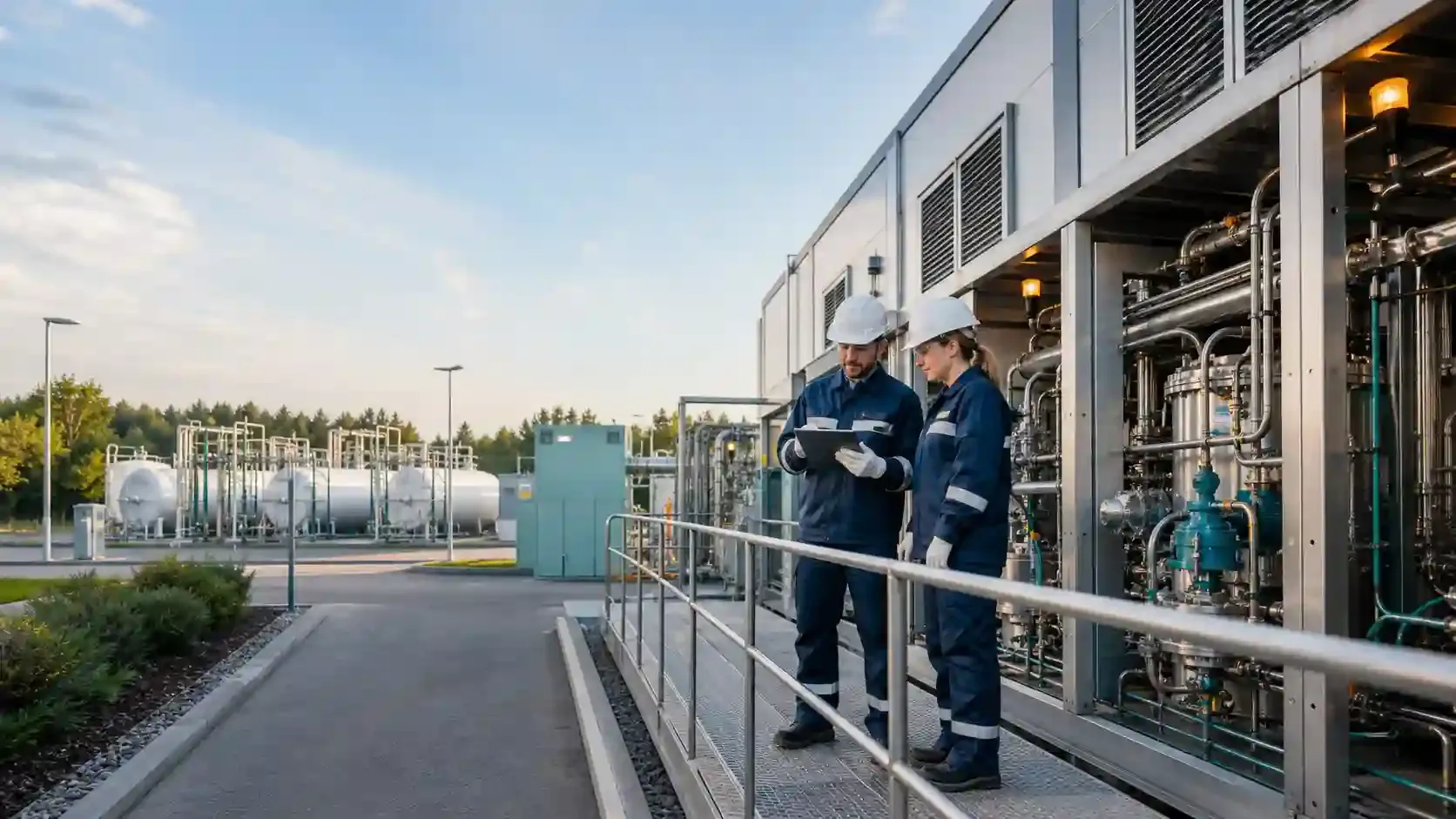
Hydrogen hazards depend on how it is produced, stored, transferred and used. Screen release, ignition, confinement, materials and emergency scenarios against the specific system.
Hydrogen safety depends on the process and storage form. A compressed-gas installation, liquid-hydrogen system, electrolyser, pipeline, refuelling station and hydrogen user have different sources, inventories, operating conditions and exposed people. Start the hazard review during design, then revisit it when the system or its operating basis changes.
The U.S. Department of Energy describes hydrogen as highly flammable, with low ignition energy and a flame that can be difficult to see in daylight. It also notes the importance of ventilation, leak detection and materials selection. These are general technical points, not a design specification: site geometry, release conditions and applicable standards determine the controls for a particular facility.
Define the hydrogen system and its interfaces
Map where hydrogen is produced, purified, compressed, stored, transferred, consumed, vented or recovered. Record its form, pressure, temperature, inventory, isolation points, operating modes and connections to other processes. If ammonia or another carrier is part of the project, analyze that material's own hazards and interfaces; do not treat ammonia as hydrogen.
Include credible deviations and release points in the hazard review. Depending on the design, questions may cover loss of containment, blocked or misdirected venting, loss of ventilation or cooling, failed isolation, incorrect purge sequence, power loss, maintenance and abnormal startup or shutdown. Use the process design and site information to select scenarios; this list is not a universal minimum.
Match the analysis to the storage form and location
For compressed hydrogen, consider pressure, inventory, potential release direction, isolation and exposure to people or ignition sources. For liquid hydrogen, also consider cryogenic contact, rapid vaporisation and the temperature limits of equipment and materials. Check whether roof spaces, enclosures, canopies, trenches or congestion could change dispersion and accumulation.
Hydrogen often rises and can disperse quickly in open conditions, but that does not establish that a release is harmless. Geometry, ventilation, release rate and ignition determine the local outcome. A modelled plume or consequence contour is conditional on the scenario and assumptions; it cannot by itself show that a layout is safe.
Select and verify controls for each scenario
Possible controls may include compatible materials and components, leak detection, ventilation, isolation, pressure relief and vent routing, ignition-source control, separation and emergency shutdown. Their suitability depends on the release and facility design. Do not treat a generic list as a complete engineered solution.
Verify that detection and response arrangements suit the conditions in which they must work. DOE guidance notes the visibility challenge posed by hydrogen flames; any flame-detection or gas-detection arrangement should be selected and located for the site's hazards and operating environment. Include inspection, testing, maintenance, bypass management, operator response and restoration in the control basis.
Connect operating changes to the risk review
Set operating limits, procedures, competence requirements and maintenance plans around the documented design basis. Review temporary bypasses, instrument or software changes, changes to storage or production capacity, new users, vent modifications and changes to emergency access through the site's management-of-change process.
At project interfaces, assign responsibility for isolation, alarm response, shutdown decisions, information sharing and incident command. Test emergency arrangements against realistic site scenarios and involve responders as appropriate to the project and local requirements.
For establishments subject to South Africa's Major Hazard Installation Regulations, Regulation 10 requires the duty holder to ensure an approved inspection authority carries out the risk assessment in accordance with SANS 1461. Whether a specific project is covered depends on the regulatory scope and site circumstances. The regulation does not by itself prescribe the hydrogen-specific controls in this article.
Frequently asked questions
Does hydrogen always rise and disperse safely?
No. Hydrogen may rise and disperse under some conditions, but roof pockets, enclosures, ventilation, congestion, release rate and ignition can change the hazard. Assess the actual geometry and release scenario.
Is liquid hydrogen the same hazard as compressed hydrogen gas?
No. Both can create fire and pressure-related hazards, but liquid hydrogen adds cryogenic temperatures and rapid vaporisation. Review each storage and transfer system on its own design basis.
Can a hydrogen consequence model establish a safe separation distance?
Not by itself. Results depend on source conditions, weather, geometry, model choices and endpoints. A competent assessment must explain those assumptions and consider other relevant scenarios and people or assets.
Does South African MHI Regulation 10 require a named hydrogen method?
Regulation 10 requires an AIA-led risk assessment in accordance with SANS 1461 for establishments within scope. It does not name one hydrogen-specific modelling package or prescribe every control for every project.
Related resources
- HAZOP study guide: method, team and follow-up
- Management of change in process safety
- Emergency planning for major hazards
- Quantitative risk analysis guide
Sources
- U.S. Department of Energy: Safe use of hydrogen (U.S. technical information on hydrogen properties and engineering controls)
- U.S. Department of Energy: Is hydrogen safe? (U.S. technical information, including material compatibility and embrittlement)
- South African Major Hazard Installation Regulations, 2022 (Regulation 10 for establishments within scope)
MMRisk supports process-safety reviews and consequence analysis. Contact our team to discuss a project-specific scope.