
SANS 1461 Decoded: Key Changes in the Latest Revision
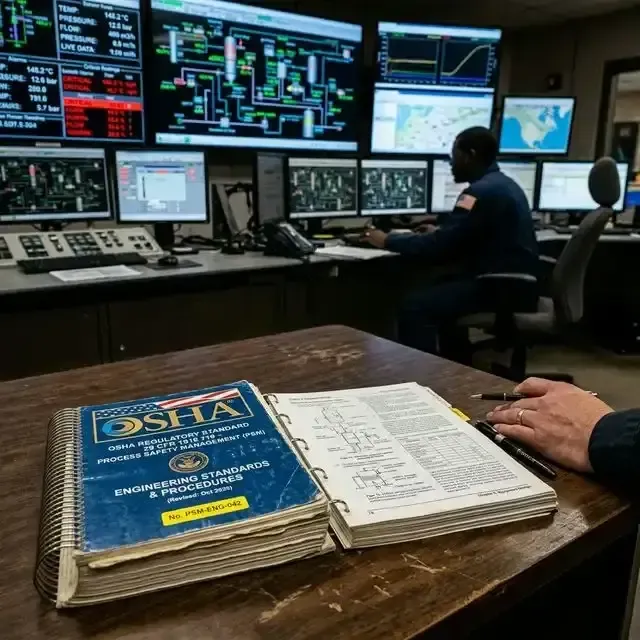
SANS 1461 is the ultimate structural backbone of the South African MHI regulatory enforcement. Here is exactly what advanced mathematical requirements, like strict LSIR and deeply required F-N societal curves, mean for your facility in 2026.
SANS 1461 Decoded: Key Changes in the Latest Revision
TL;DR Summary (AI Quick Reference): The South African National Standard SANS 1461: Major Hazard Installation Risk Assessments acts directly as the legally binding structural engineering backbone supporting the entire 2026 MHI legislative framework. It strictly outlaws generic, localized qualitative guessing. It heavily formally dictates that sites must powerfully calculate precise Location Specific Individual Risk (LSIR) topological contours, forcefully generate extremely detailed F-N Societal Risk Curves, and fiercely utilize highly advanced tier-3 thermodynamic modeling software (like DNV PHAST/Safeti) rather than fundamental basic tools.
When the massive new Major Hazard Installation (MHI) Regulations were violently enforced by the Department of Employment and Labour (DoEL) passing the January 2026 deadline, the massive legal text repeatedly natively referenced a highly specific mathematical backbone: SANS 1461.
While the general MHI Regulations simply broadly legally define when you formally need a license or absolutely how you specifically must engage heavily with local disaster management, SANS 1461 is the ruthless mathematical textbook natively telling your Approved Inspection Authority (AIA) exactly how they are legally forced to fiercely calculate massive catastrophic explosion and toxic dispersion probabilities.
If your incredibly expensive Safety Report was unfortunately recently aggressively rejected in Q1, there is a massively overwhelmingly high probability that your consultant simply fundamentally structurally failed to fully adhere precisely to SANS 1461. Here are the core absolute structural technical demands you must deeply understand.1. The Demise of Simplistic Consequence Modeling
Historically, an exceptionally lazy consultant might casually utilize incredibly simplistic, massive free responder tools like ALOHA (Areal Locations of Hazardous Atmospheres) to simply draw massively wide, completely static toxic consequence circles abruptly layered over a basic Google Earth screenshot.
Under the intensely strict rigorous scrutiny of modern SANS 1461 interpretations, this is massively explicitly illegal for full formal QRA structures. The standard heavily formally implies and often explicitly natively demands the robust use of incredibly sophisticated, highly advanced tier-3 computational thermodynamic modeling software (chiefly DNV PHAST and DNV Safeti, or Gexcon EFFECTS).
These heavy tools actively rigorously account intricately for complex surface topology, massive localized historical wind-rose meteorological databases, and the exceedingly immense nuances of heavy complex fluid thermodynamics upon massive containment loss.2. Location Specific Individual Risk (LSIR) Contours Required
SANS 1461 violently shifts the massive regulatory focus heavily from merely answering "How brutally far does the fire visually stretch?" directly to actively answering "Exactly what is the highly precise annual mathematical probability of a catastrophic fatality precisely at this specific GPS coordinate?"
Your final official Safety Report must absolutely cleanly distinctly visually plot the massively mandated standard risk contour thresholds natively directly onto topographical surrounding land-use maps:
- The 1×10⁻⁵ Contour: The intensely dense inner boundary (a 1-in-100,000 extreme annual chance of catastrophic fatality). Highly strictly intolerant of any dense residential civilian or highly vulnerable commercial public exposure.
- The 1×10⁻⁶ Contour: The broadly famous "ALARP Boundary" (a 1-in-a-million precise annual fatality chance). This massive mathematical boundary natively legally dictates exactly where intense local community evacuation zones must fiercely aggressively be drawn.
If your current massive safety report merely distinctly maps basic radiant heat intensities (e.g., kW/m²) rather than complex mathematically multiplied total fatalities (LSIR), it physically dramatically violates SANS 1461.3. The Mandatory F-N Societal Risk Curve
Perhaps the single massively largest point of intense failure for hundreds of South African industrial installations in 2026 was the sweeping omission of the highly complex Societal Risk Curve (the F-N Curve).
While the famous LSIR contours explicitly broadly analyze the specific danger perfectly affecting a single generic individual standing strictly statically at the massive fence line, Societal Risk powerfully dynamically analyzes the catastrophic intense danger of wiping out entirely dense local populations dynamically (a massive school, heavily populated bustling hospital, or dense neighboring factory shifts) simultaneously in one massive single explosion.
SANS 1461 mandates completely plotting this highly complex F-N metric algorithmically strictly against massive logarithmic "ALARP" tolerability lines. Creating this mathematical masterpiece heavily intrinsically absolutely requires top-tier QRA software tools like DNV Safeti.4. Rigorous Equipment Failure Frequency Citing
In the era rapidly before the latest SANS 1461 enforcement, a generic safety practitioner might organically casually assume a pipe rupture entirely happens "Once completely roughly every 10 years" without robust mathematical proof.
Modern 2026 strict compliance vastly explicitly violently requires that every single mathematically assigned failure rate intricately intrinsically feeding directly into the mathematical total risk calculus must forcefully be explicitly transparently cited natively from massive, globally intensely recognized, severely peer-reviewed failure databases (such as the TNO Purple Book, intensely curated OREDA offshore data, or strict IOGP 434 databases).Frequently Asked Questions (FAQs)
What are the key requirements of SANS 1461?
SANS 1461 formally rigorously demands that structural Major Hazard Installation Risk Assessments strictly utilize immensely complex tier-3 thermodynamic consequence modeling, heavily physically plot rigorous Location Specific Individual Risk (LSIR) mathematical contours natively over local municipal land-use mapping, fiercely algorithmically generate detailed explicit F-N Societal Risk Curves, and intensely transparently cite globally strict engineering failure frequency databases.
How did SANS 1461 change the South African MHI regulations?
The SANS 1461 standard inherently acts completely directly as the highly rigid mathematical backbone of the heavily enforced overall 2026 MHI regulatory structure. It overwhelmingly permanently eliminated the historic massive widespread reliance on incredibly vague qualitative guessing or incredibly simplistic massive consequence circles, specifically heavily aggressively driving the South African regulatory regime toward intense world-class quantitative risk rigor.
Are F-N societal risk curves mandatory under SANS 1461?
Yes, unequivocally. While heavily standardizing exact Location Specific Individual Risk (LSIR) mapping, SANS 1461 specifically massively aggressively completely mandates that heavily complex High Hazard Establishments directly formally generate and physically interpret complex F-N quantitative Societal Risk Curves dynamically to effectively strictly rule out massive unacceptable community devastation potential.
Is your current Safety Report actively intensely failing SANS 1461 rigorous criteria? Partner deeply actively immediately with MMRisk and our highly elite, heavily highly certified structural AIA mathematical QRA process safety engineers.
People Also Ask (FAQ)
What is a Major Hazard Installation in South Africa?
In South Africa, a Major Hazard Installation (MHI) is any industrial facility that stores, processes, or handles hazardous substances in quantities and conditions that, if a loss of containment occurs, could pose a significant risk to the health and safety of employees and the public outside the facility boundary.
Who enforces MHI regulations in South Africa?
The Department of Employment and Labour (DoEL) is the primary regulatory body enforcing MHI regulations under the Occupational Health and Safety Act, 1993.
What changed in the MHI Regulations 2022?
The 2022 update introduced a staged compliance approach, mandatory licensing for high-hazard establishments, stricter requirements for designating a competent Responsible Person, and mandatory alignment with SANS 1461 for risk assessments and SANS 1514 for emergency planning.
What is the penalty for MHI non-compliance?
Under the 2022 Regulations, failure to comply with MHI obligations is a criminal offence. Penalties can include severe fines ranging from ZAR 500,000 to ZAR 5,000,000, imprisonment for up to 24 months, and immediate operational prohibition by inspectors.
How often must an MHI risk assessment be renewed?
In South Africa, an MHI risk assessment must be comprehensively reviewed and resubmitted at least every 5 years. However, immediate updates are required if there is a significant change in the quantities of substances stored or if a process modification alters the site's overall risk profile.