
HAZOP Study Basics: The Guide Words You Must Know
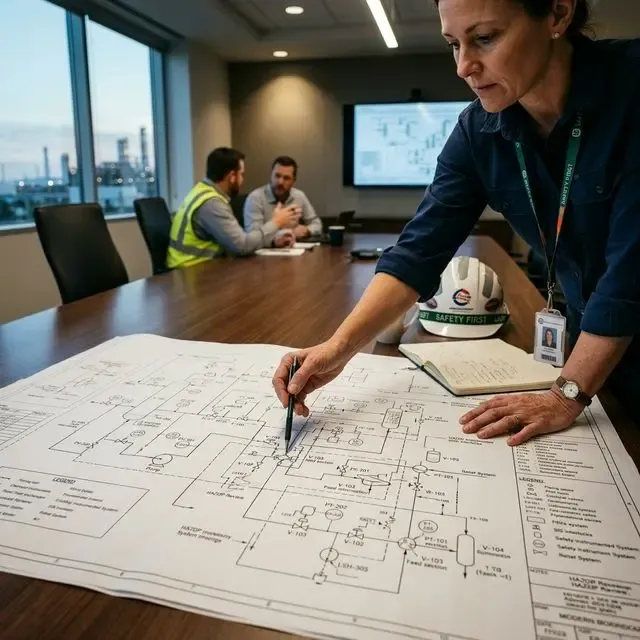
Use this practical HAZOP guide-word reference to turn design intent into useful deviations, causes, safeguards and actions during a workshop.
HAZOP Guide Words: A Practical Reference for Better Workshops
Quick answer: Start with the design intent, pair one process parameter with one guide word, then record the deviation, credible causes, consequences, existing safeguards and actions. For example: flow + no = no flow. Do not jump straight to solutions before the team agrees on the deviation and its causes.
Use this 60-second HAZOP sequence
Step Ask the team Example for a cooling-water line 1. Design intent What should this node do? Supply cooling water to remove reactor heat. 2. Parameter What can vary? Flow, pressure, temperature, composition. 3. Guide word How could it deviate? No flow. 4. Causes What could make that real? Closed valve, pump trip, blocked strainer. 5. Consequences What happens if safeguards fail? Reactor temperature rises; relief or shutdown may be demanded. 6. Safeguards and actions What is independent, tested and adequate? Low-flow alarm, trip, procedure, inspection action. Use the downloadable guide-word reference card at the workshop table, then follow it with a worked HAZOP example when the team needs a model answer. The Hazard and Operability (HAZOP) methodology gives multidisciplinary teams a repeatable way to test design intent. A guide word is not a risk rating and it does not replace engineering judgement; it is the prompt that makes a workshop systematic rather than an unstructured brainstorm. The most common failure point? An improper, rushed, or incomplete application of the critical HAZOP Guide Words. If your facility is updating its Major Incident Prevention Policy (MIPP) or preparing for a regulatory audit, retain the node boundaries, assumptions, guide words, safeguards and action close-out evidence alongside the study record. What Are HAZOP Guide Words?
In technical terms, a Guide Word is a simple, universally recognized verb or adjective used to stimulate creative engineering thought regarding how a specific process parameter might deviate from its intended design intent.
When a Guide Word is mathematically paired with a Parameter (the property of the fluid or process), it creates a specific Deviation.
Parameter (FLOW) + Guide Word (MORE) = Deviation (MORE FLOW/HIGH FLOW)
The multidisciplinary engineering team then systematically analyzes what would cause MORE FLOW to happen (the Cause), what the catastrophic result would be (the Consequence), and what engineered layers exist to stop it (the Safeguards).The 7 Primary Guide Words Every Engineer Must Know
While highly complex chemical facilities might employ up to 15 distinct guide words, the structural core of any functional HAZOP rests upon these fundamental 7 concepts:
1. NO or NOT
Definition: The complete negation of the design intent. Absolutely nothing happens when it is supposed to.
- Example (NO FLOW): A blocked pipeline, an inadvertently closed isolation valve, or a massively failed transfer pump.
- Engineering Impact: For exothermic reactors, NO FLOW of cooling water immediately results in a thermal runaway and inevitable catastrophic vessel rupture.
2. MORE (or HIGH)
Definition: A quantitative increase in the specified parameter entirely beyond safe design limits.
- Example (MORE PRESSURE): A downstream blockage combined with rapid upstream thermal expansion, or a totally failed pressure regulator.
- Engineering Impact: Structural vessel fatigue, blown flange gaskets leading directly to massive toxic atmospheric releases, or pipe burst.
3. LESS (or LOW)
Definition: A quantitative decrease in the specified parameter below minimal operational limits.
- Example (LESS LEVEL): A massive tank leak, a failed level transmitter resulting in a pump inadvertently draining a vessel completely dry.
- Engineering Impact: Cavitation destroying critical centrifugal pumps, or catastrophic loss of a liquid seal allowing highly flammable gas to blow-by into a massive low-pressure storage tank (a leading cause of refinery explosions).
4. AS WELL AS
Definition: A qualitative modification indicating an additional activity or material is present alongside the intended design.
- Example (AS WELL AS COMPOSITION): Trace water leaking rapidly into an incompatible concentrated sulfuric acid storage tank.
- Engineering Impact: Violent, highly unpredictable exothermic reactions, severe rapid corrosion rates, or the accidental generation of toxic off-gases.
5. PART OF
Definition: A qualitative modification indicating that only a fraction of the intended activity or material is currently present.
- Example (PART OF COMPOSITION): A chemical blend intentionally designed with an inhibitor entirely missing the required inhibitor chemical.
- Engineering Impact: Sudden uncontrollable polymerization within pipelines and storage vessels, demanding highly explosive emergency venting.
6. REVERSE
Definition: The logical opposite of the intended physical direction or sequence.
- Example (REVERSE FLOW): A completely failed non-return valve (check valve) allowing high-pressure highly toxic inventory to flow linearly backward into a low-pressure safe utility system (like the municipal water lines).
- Engineering Impact: Extreme lethal contamination of plant-wide safe utilities or severe overpressurization of upstream low-grade piping not rated for the subsequent stress.
7. OTHER THAN
Definition: Complete substitution. Something completely completely different occurs.
- Example (OTHER THAN OPERATION): Maintenance operators inadvertently cross-connecting a massive liquid ammonia hose physically into a pressurized nitrogen purge manifold.
- Engineering Impact: Incalculable massive incident potentials dependent solely upon the incompatibility of the substituted material or radically incorrect sequence.
Avoid the three guide-word mistakes that weaken a HAZOP
- Using every guide word mechanically. Apply only guide words that make sense for the parameter and document why a combination is not meaningful.
- Treating an alarm as the entire safeguard story. Record the detector, decision logic, final element, response time, testing and operator action where relevant.
- Closing the workshop without action ownership. Assign an owner, due date and technical close-out evidence for every action.
A skilled HAZOP facilitator keeps the discussion on the design intent, brings the right disciplines into the room and ensures action close-out is traceable. For a wider view of study quality, see our complete HAZOP study guide.Frequently Asked Questions (FAQs)
What is the main purpose of HAZOP guide words?
The primary purpose of HAZOP guide words is to systematically and structurally force a multidisciplinary engineering team to brainstorm every conceivable way a process can organically deviate from its safe design intent, ensuring no catastrophic failure mode remains dangerously unidentified.
How many guide words should be used in a standard HAZOP?
While the exact number varies by immense process complexity, a standard foundational HAZOP must employ at least the 7 core guide words: NO, MORE, LESS, AS WELL AS, PART OF, REVERSE, and OTHER THAN. Highly complex batch chemical reactors often require up to 15 specialized modifiers.
Can a HAZOP be performed without guide words?
Absolutely not. A risk assessment performed completely without the systemic structural application of paired guide words is technically merely a "What-If" analysis or a high-level HAZID, fundamentally lacking the deep rigor required by modern Major Hazard Installation (MHI) regulations.
Contact the MMRisk engineering team today to schedule an expertly facilitated, legally defensible, and rigorously thorough HAZOP workshop for your highly complex facility.