
The 'Domino Effect' in Industrial Parks
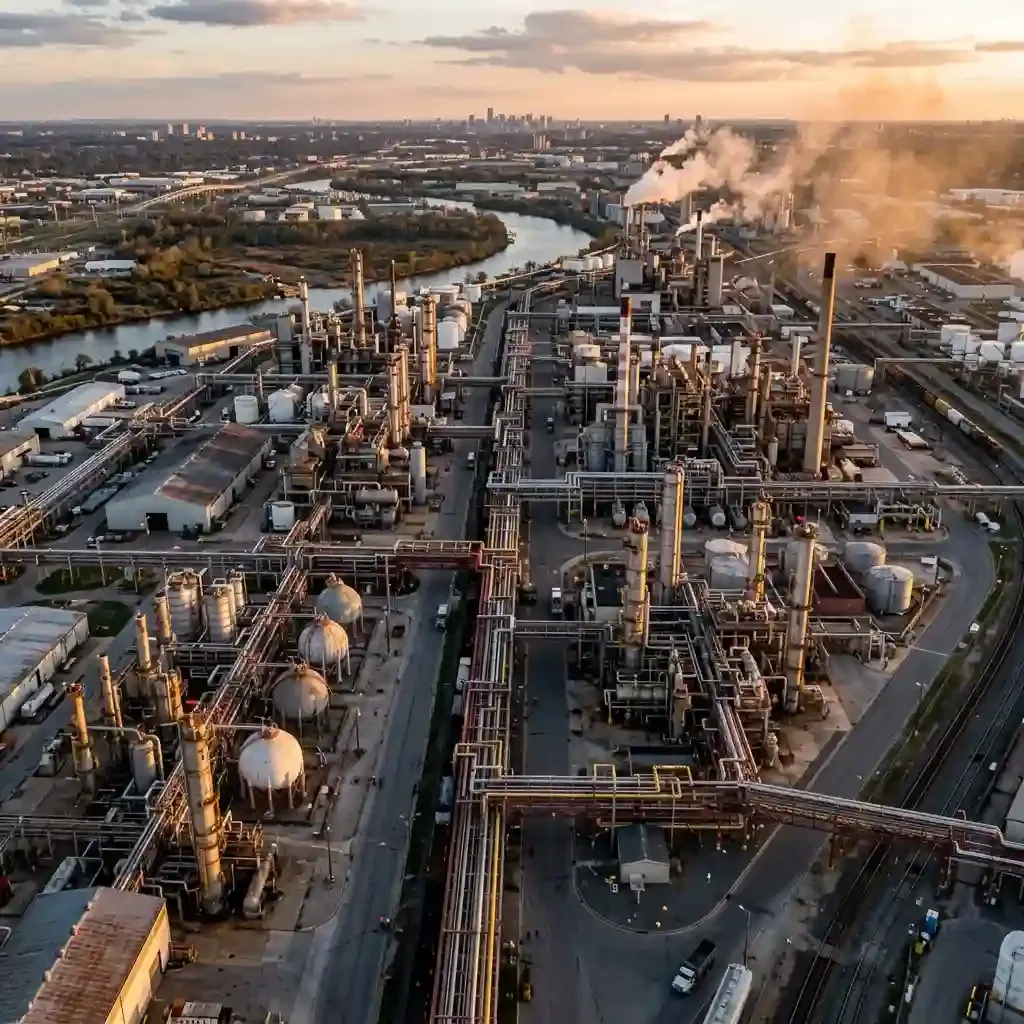
When industrial facilities are built too close together, a minor fire at one plant can trigger a catastrophic explosion at another. Understand and mitigate domino escalation.
The "Domino Effect" in Industrial Parks
In process safety, the worst-case scenario isn't just an incident occurring—it is an incident escalating out of control. When the consequences of a primary accident (like a fire or explosion) trigger a secondary, often larger accident in adjacent equipment or neighboring facilities, it is known as the Domino Effect.
As South Africa's industrial hubs and special economic zones become more densely populated, the risk of cross-boundary domino escalation has become a primary focus of the Department of Employment and Labour (DoEL).
How Domino Escalation Works
Domino effects occur because the physical energy released by an initial failure compromises the physical integrity of a nearby, independent system. This happens via three primary vectors:
1. Thermal Radiation (Heat)
A primary fire (such as a pool fire or jet fire) generates intense heat. If an adjacent pressurized vessel is exposed to this heat flux, the steel weakens, and the internal pressure rises. If the heat is not mitigated (via cooling water deluge), the secondary vessel will rupture, potentially causing a massive BLEVE.
- The Threshold: A sustained heat flux of 37.5 kW/m² is generally considered enough to cause structural failure in neighboring equipment.
2. Overpressure (Blast Waves)
A primary explosion (such as a Vapor Cloud Explosion) generates a high-pressure shockwave. If this blast wave strikes a neighboring storage tank or pipe rack, the physical force can rupture the steel, releasing more hazardous material.
- The Threshold: An overpressure of 30 kPa to 50 kPa can cause significant damage to atmospheric storage tanks and heavy structural damage.
3. Missile Projection (Shrapnel)
When a vessel explodes, heavy steel fragments are launched at high velocities. If a fragment strikes a neighboring pipe or vessel, it acts like a projectile, puncturing containment and triggering a secondary release.
The Legal Implications in Industrial Parks
The MHI Regulations explicitly require facilities to consider how their operations affect their neighbors. However, the domino effect forces you to also consider how your neighbors affect you.
If you build a new chemical plant next door to an existing refinery, their risk becomes your risk.
- Shared Risk Contours: If a neighboring facility's $10^{-6}$ individual risk contour overlaps with your property, your workers are exposed to their hazard.
- Escalation Modeling: In a Quantitative Risk Assessment (QRA), engineers must model whether a fire on your site could escalate and destroy your neighbor's infrastructure (and vice versa).
Mitigating the Domino Effect
The most effective way to prevent domino escalation is through Inherently Safer Design (ISD) implemented during the feasibility and layout phases:
- Spatial Separation: Ensuring adequate distance between high-hazard units.
- Passive Barriers: Building blast walls or fire-rated concrete partitions between highly critical process areas.
- Active Protection: Installing automated water deluge systems that activate not just on the burning equipment, but on adjacent equipment to keep it cool and prevent secondary failure.
Do You Know Your Neighbor's Risk?
You cannot operate in a silo. Protecting your facility means understanding the domino potential of the entire industrial park.
At MMRisk, our advanced modeling software maps complex, multi-facility escalation scenarios. Contact us today to evaluate your site layouts and ensure you aren't sitting in the blast radius of a domino effect.