
Fire & Explosion Modeling: BLEVEs and Jet Fires
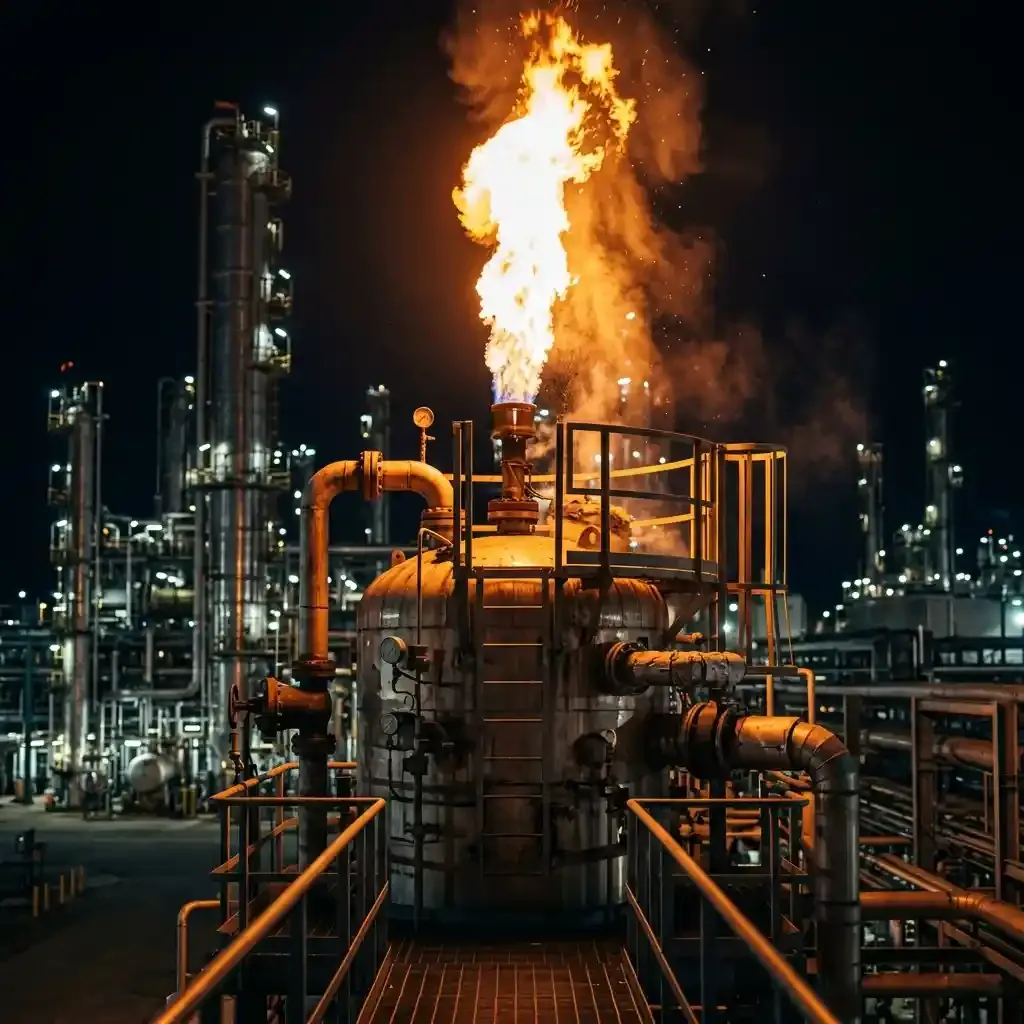
From the devastating power of a BLEVE to the cutting heat of a jet fire, understanding specific fire hazards is the first step in preventing catastrophic domino effects.
Fire & Explosion Modeling: BLEVEs and Jet Fires
When analyzing major industrial hazards, we must look beyond the simple classification of "flammable." Different containment failures lead to drastically different types of fires, each with unique behavioral characteristics, heat signatures, and destructive potentials.
For facilities handling pressurized flammable liquids or gases—such as LPG depots, refineries, or chemical manufacturing plants—two of the most critical scenarios evaluated in a Quantitative Risk Assessment (QRA) are the Jet Fire and the BLEVE.
Understanding how these fires behave through rigorous Consequence Modeling is a strict requirement for compliance with the South African Major Hazard Installation (MHI) Regulations.
The Jet Fire: The Industrial Blowtorch
A jet fire occurs when a pressurized flammable gas or liquid is released through a hole or ruptured pipe and immediately ignites.
Characteristics of a Jet Fire
Because the fuel is being forced out under pressure, a jet fire does not burn vertically like a campfire. Instead, it creates a highly directional, high-velocity flame—essentially a massive industrial blowtorch.
- Extreme Heat Flux: Jet fires generate intense localized heat. While a standard pool fire might generate thermal radiation levels around $50 kW/m^2$ near the flame surface, a high-pressure jet fire can easily exceed $200 kW/m^2$ to $300 kW/m^2$.
- Impingement Risk: The greatest danger of a jet fire is flame impingement. If the high-velocity flame strikes an adjacent piece of equipment, a pipe rack, or a storage vessel, the targeted steel can lose its structural integrity within minutes.
Modeling Jet Fires
In our modeling (using tools like PHAST), we calculate the length of the flame and the thermal radiation contours extending from it. We specifically look for the $37.5 kW/m^2$ contour, which represents the threshold for immediate equipment damage and 100% fatality. If this contour touches other critical infrastructure, we must model a potential Domino Effect escalation.
The BLEVE: The Nightmare Scenario
BLEVE stands for Boiling Liquid Expanding Vapor Explosion. It is universally considered one of the most catastrophic events that can occur at an industrial facility. The tragic 2022 Boksburg gas tanker explosion is a harrowing local example of a BLEVE.
How a BLEVE Occurs
A BLEVE typically involves a pressure vessel containing a liquid that is stored at a temperature above its normal boiling point (like LPG, which is a gas at room temperature but compressed into a liquid for storage).
- External Fire: A fire (often a pool fire or jet fire) breaks out near or directly beneath the pressure vessel.
- Heating and Weakening: The fire heats the liquid inside, causing the pressure to rise. Simultaneously, the fire heats the metal wall of the vessel in the "vapor space" (the area above the liquid level where there is no liquid to absorb the heat). The metal rapidly weakens.
- Catastrophic Rupture: The weakened metal tears open. The pressurized liquid is suddenly exposed to atmospheric pressure.
- Massive Expansion and Ignition: The liquid instantly flashes into vapor, expanding to hundreds of times its original volume in milliseconds. If the substance is flammable, this massive expanding vapor cloud ignites, creating a colossal, rising fireball.
Characteristics of a BLEVE
- The Fireball: BLEVE fireballs can be hundreds of meters in diameter. They lift off the ground, radiating immense heat over a massive area.
- Blast Wave: The sudden expansion of the flashing liquid creates a significant overpressure blast wave that can destroy nearby buildings.
- Missile Fragments: The steel vessel itself is torn apart, sending heavy shrapnel flying hundreds of meters in all directions.
Modeling BLEVEs
When MMRisk engineers model a BLEVE, we calculate three distinct hazard zones:
- The radius and duration of the fireball (to calculate thermal radiation lethality).
- The overpressure contours from the blast wave.
- The maximum projection distance of vessel fragments.
Because a BLEVE impacts such a vast area, the thermal radiation contours (specifically the $12.5 kW/m^2$ and $4.7 kW/m^2$ zones) almost always extend beyond the site boundary, triggering immediate MHI classification.
Prevention is Cheaper than the Cure
You cannot fight a BLEVE once the metal begins to tear. The only defense is prevention.
Robust process safety engineering relies on multiple layers of protection to ensure these scenarios never materialize:
- Active Fire Protection: Deluge systems designed to keep vessel walls cool during an external fire.
- Passive Fire Protection: Intumescent coatings on vessel skirts and structural supports to delay steel failure.
- Inherently Safer Design: Ensuring adequate spacing between vessels to prevent jet fire impingement.
For seasonal preparation, use the Winter Industrial Fire Risk Guide for South African Facilities to review ignition control, firewater readiness, temporary heating, and dry vegetation exposure.
If your facility operates pressurized flammable systems, you need absolute certainty regarding your risk profile. Contact MMRisk's SANAS-accredited engineers to schedule your comprehensive QRA and ensure your layers of protection are up to standard.