
Vapor Cloud Explosions (VCE): The Silent Killer
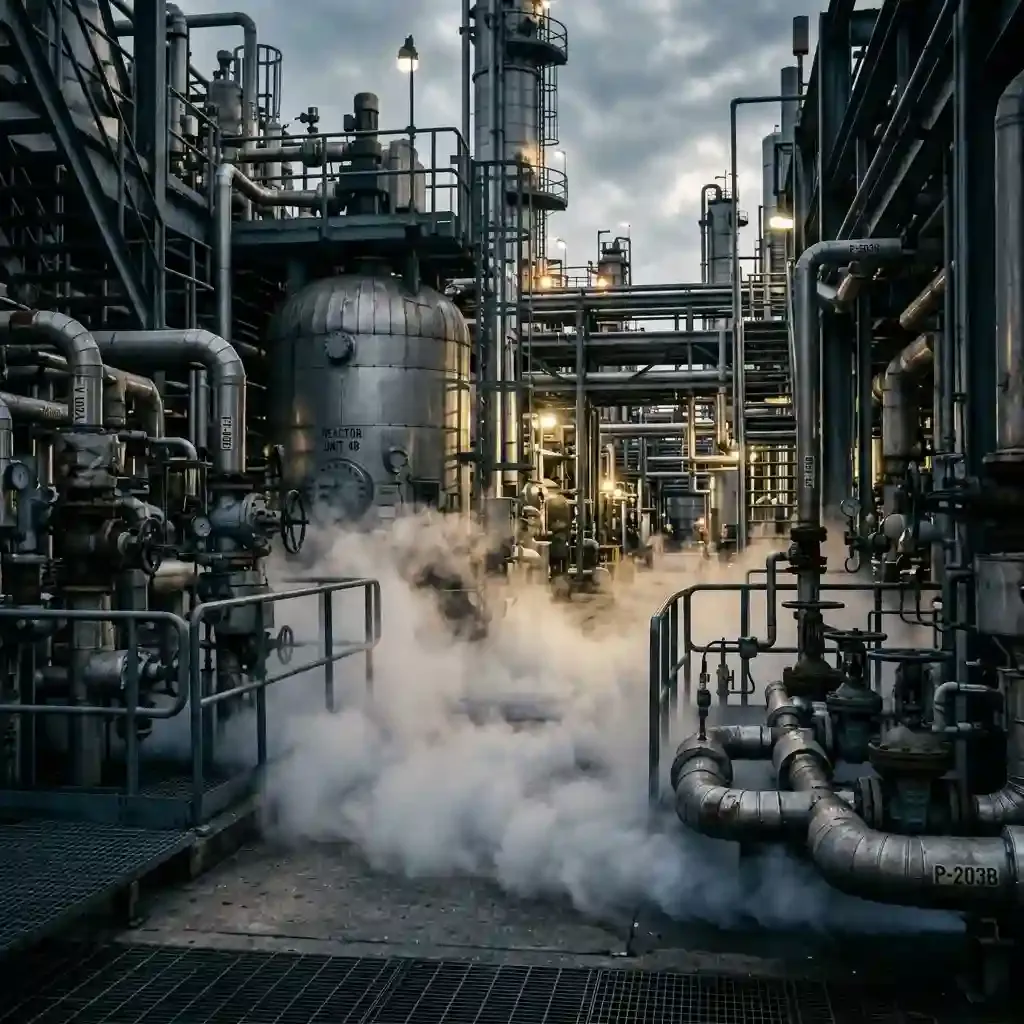
Gas leaks don't just cause fires; they cause catastrophic explosions. Learn how congestion and confinement turn a drifting vapor cloud into a devastating overpressure blast.
Vapor Cloud Explosions (VCE): The Silent Killer
Quick answer: a release becomes a VCE concern when a flammable cloud can form, find an ignition source and burn through congestion or confinement that accelerates the flame. The first controls are to prevent loss of containment, limit inventory, detect and isolate the release quickly, and avoid creating congested or enclosed ignition zones.
VCE, flash fire or jet fire: identify the scenario first
Scenario What drives harm Practical design question Flash fire People exposed within the flammable cloud Could people be inside the cloud before ignition? Jet fire Directional thermal radiation from a pressurised release Can isolation reduce duration and can equipment withstand radiation? Vapor cloud explosion Flame acceleration in congestion or confinement Can the cloud enter dense pipework, a building or another restricted area? This distinction matters because the model, safeguards and emergency plan should follow the credible scenario—not a generic “explosion radius.” When a flammable gas or highly volatile liquid leaks into the open air, the immediate assumption is often the risk of a fire. However, if that gas is allowed to mix with air and drift into the wrong area before igniting, the result is not a fire—it is a Vapor Cloud Explosion (VCE). VCEs are responsible for some of the most destructive industrial disasters in history, including the 1974 Flixborough disaster and the 2005 Buncefield explosion. Understanding the mechanics of a VCE is critical for Process Safety Management and is a foundational element of any Quantitative Risk Assessment (QRA) conducted for MHI compliance in South Africa.
The Anatomy of a VCE
A Vapor Cloud Explosion does not happen simply because a gas ignites. If you ignite a gas cloud in a completely empty, open field, you will likely get a "flash fire"—a rapid burn that is lethal to anyone inside the cloud, but produces very little explosive blast wave (overpressure).
For an explosion to occur, the flame must accelerate to supersonic or near-supersonic speeds. This acceleration is driven by two critical environmental factors: Congestion and Confinement.1. Congestion: The Obstacle Course
"Congestion" refers to the density of obstacles in the path of the expanding flame. In a petrochemical plant, a pipe rack, a cluster of distillation columns, or a dense arrangement of pumps and valves all represent high congestion.
When a drifting vapor cloud enters a congested area and ignites, the expanding flame pushes unburned gas ahead of it. As this gas rushes past the pipes and vessels, it creates turbulence. Turbulence increases the surface area of the flame, which makes it burn faster, which creates more turbulence. This feedback loop rapidly accelerates the flame front until it generates a destructive shockwave.2. Confinement: Trapping the Pressure
"Confinement" refers to physical barriers that trap the expanding gases, preventing them from venting in all directions.
- A gas compressor located inside a four-walled building is highly confined.
- A vapor cloud igniting in a confined space will generate significantly higher overpressures than one igniting in the open air, often resulting in the complete destruction of the enclosing structure.
Measuring the Destruction: Overpressure Thresholds
When MMRisk engineers perform Consequence Modeling for a VCE, we calculate the blast wave's "overpressure" (measured in kilopascals (kPa) or Bar). We use these calculations to map damage contours across the facility and surrounding community.
Indicative overpressure thresholds are useful for communicating potential effects, but the correct consequence criteria, weather assumptions, release cases and model settings must be selected for the facility and its assessment purpose. Common reference points include:
- 7 kPa (0.07 bar): The threshold for widespread window glass breakage. Flying glass is a major cause of injury to the public during a VCE.
- 14 kPa (0.14 bar): Minor structural damage to conventional buildings.
- 21 kPa (0.21 bar): The threshold for human eardrum rupture.
- 35 kPa (0.35 bar): Heavy building damage; partial collapse of walls and roofs.
- 70 kPa (0.70 bar): Severe structural damage can be expected in many conventional cases.
An off-site contour is a signal to examine land-use, emergency planning and MHI obligations carefully; it is not, by itself, a classification decision. Use a documented QRA and the applicable South African regulatory criteria.
Designing Against the VCE Threat
Because the severity of a VCE is dictated by the environment, process safety engineers can proactively design facilities to minimize the risk. This is the essence of Inherently Safer Design (ISD).
- De-congestion: Designing plant layouts with adequate spacing between equipment units to prevent the flame acceleration feedback loop.
- Removing Confinement: Utilizing open-sided structures or grated floors for compressor houses rather than solid walls, allowing any overpressure to vent safely rather than build up.
- Rapid Detection and Isolation: Installing highly responsive gas detection systems linked to automated emergency shutdown (ESD) valves to limit the size of the vapor cloud before it can drift into congested zones.
A practical VCE walkdown
Walk the release path, not just the equipment list:
- Identify credible loss-of-containment points and available isolations.
- Mark congested pipe racks, enclosed rooms, drainage routes and low points where vapour can accumulate.
- Confirm detector placement, alarm response, isolation time and proof-test arrangements.
- Check whether temporary structures, stored materials or modifications have created new congestion.
- Use consequence modelling to test layout and emergency-response assumptions before relying on a fixed distance rule.
For related safeguards, see consequence modelling, LPG installation risks and inherently safer design.
Are your plant layouts creating unintended VCE hazards? Ensure your facility is safe, compliant, and optimized. Contact the expert engineers at MMRisk to evaluate your site layouts and conduct a comprehensive QRA.