
Permit to Work: The Barrier Between Maintenance and a Major Incident
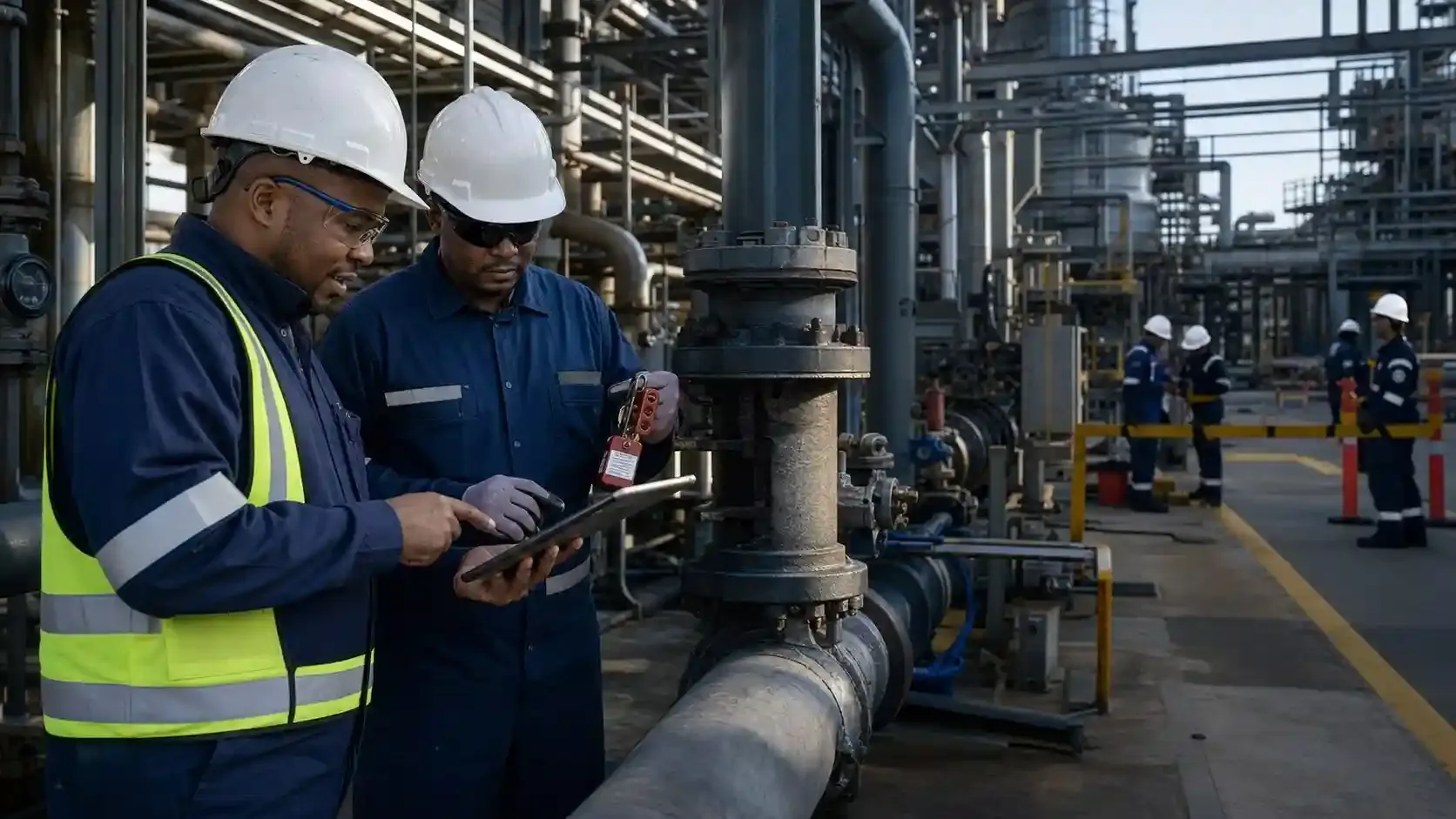
Strengthen your permit-to-work system with clear roles, verified isolations, task-specific controls, shift handovers, and disciplined closeout.
Permit to Work: The Barrier Between Maintenance and a Major Incident
A welder holds a valid hot-work permit. Ten metres away, another team opens a hydrocarbon line under a separate permit. Each job looks controlled on paper. Together, they create an ignition source beside a release point.
A permit-to-work (PTW) system controls hazardous work by coordinating the task, plant condition, people, isolations, and other work in the area. The permit records the agreement, but the field controls make the job safe.
Download: MMRisk Permit-to-Work System Audit Checklist (PDF) or use the print-friendly version.
Use permits for work that needs formal control
Permit categories depend on the facility, but common examples include:
- hot work and spark-producing work;
- confined-space entry;
- breaking containment or line opening;
- electrical and process isolation;
- excavation and ground disturbance;
- work at height;
- radiography;
- lifting over live plant;
- disabling fire protection, gas detection, alarms, trips, or shutdown systems.
Do not issue a permit for every routine task. Too many permits overload the system and hide the work that needs stronger control. Define permit triggers from hazards, energy sources, and possible interaction with the process.Plan the work before filling in the form
The job owner should define:
- the exact task and equipment boundary;
- tools, materials, and work method;
- hazardous substances and energy sources;
- required isolations and tests;
- permit type and supporting certificates;
- people, competence, and supervision;
- worksite conditions and nearby activities;
- emergency and rescue arrangements.
Attach the risk assessment, method statement, isolation certificate, gas-test record, lift plan, confined-space certificate, or other supporting document where required.
A copied permit from yesterday does not prove that today's plant condition is the same.Make roles explicit
The issuing authority controls the plant and confirms that the process conditions support the work. The performing authority controls the work party and confirms that the team understands the task and precautions.
Sites may use different role names. The responsibilities should still cover:
- defining and preparing the work;
- isolating and proving the equipment;
- inspecting the worksite;
- authorising the permit;
- accepting and briefing the work party;
- supervising changing conditions;
- suspending or extending work;
- handing the job across shifts;
- inspecting and returning the plant to service.
Avoid one person issuing and accepting the same high-risk permit unless the site's risk assessment supports that arrangement.Verify isolations in the field
An isolation drawing or certificate needs field proof.
Check:
- equipment identity and tag numbers;
- electrical, mechanical, hydraulic, pneumatic, thermal, chemical, and stored energy;
- isolation method and required standard;
- lock and tag ownership;
- drain, vent, purge, flush, and depressurisation;
- zero-energy or gas-test result;
- shared systems and possible cross-flow;
- restoration sequence.
For line opening, consider trapped pockets, dead legs, incorrect valve line-up, leaking valves, and material left between isolation points.Manage simultaneous operations
The permit office or area authority needs a live picture of work in the unit.
Review conflicts such as:
- hot work near breaking containment;
- crane lifts over operating equipment;
- excavation near buried services;
- confined-space entry affected by nearby chemicals or exhaust;
- firewater or detection impairment during hazardous work;
- startup or transfer operations near maintenance;
- multiple teams relying on the same isolation.
Use a permit board, map, digital overview, or coordination meeting that shows location, status, isolation, and interaction. The system should help people see conflicts before work begins.
AIChE's SIMOPS safe-work practice guidance treats the work permit as the place where engineering and administrative controls are confirmed for interacting activities. That is why the permit review should test combined conditions in the field, not only whether each individual job has a completed form.Test the controls at the job site
The issuing and performing authorities should visit the worksite together for high-risk work. Confirm that:
- the equipment and work location match the permit;
- the stated hazards reflect field conditions;
- isolations and barricades are in place;
- gas testing uses the correct locations and frequency;
- ventilation, rescue, fire watch, and emergency access are ready;
- the work party understands stop conditions.
Ask a worker to explain the main hazard, the isolation boundary, and the action if conditions change. A signature cannot replace understanding.Keep the permit alive during the work
Conditions change through weather, process operation, nearby work, loss of ventilation, alarm, gas-test result, staffing, or equipment state.
Suspend the permit when:
- the scope changes;
- an alarm or emergency occurs;
- gas readings exceed limits;
- an isolation becomes uncertain;
- the shift changes without formal handover;
- another task creates a conflict;
- safeguards or emergency arrangements become unavailable.
The team should stop, make the area safe, and revalidate or reissue the permit.Control shift handover and extensions
The UK Health and Safety Executive identifies shift handover as a key permit-to-work human-factors issue. The incoming people need the same understanding as the original issuer and work party.
For a handover:
- inspect the site;
- review work completed and remaining;
- confirm plant and isolation status;
- repeat gas testing where required;
- identify changes and nearby work;
- record new names, time, and authorisation.
Do not extend a permit by changing the expiry time without reviewing conditions.Close the permit and return the plant
Closeout needs two checks: the work is complete, and the plant is ready for restoration.
Confirm:
- people, tools, waste, temporary earths, blinds, hoses, and scaffolding are accounted for;
- guards, insulation, fireproofing, labels, instruments, and drains are restored;
- the worksite is clean and accessible;
- maintenance records and test results are complete;
- the operations team knows the equipment status;
- isolations are removed under control;
- a PSSR or MOC action is complete where required.
Audit work in the field
Measure more than permit counts. Review:
- permit quality and task specificity;
- field compliance with stated controls;
- isolation deviations;
- gas-test quality;
- overdue or repeatedly extended permits;
- handover quality;
- simultaneous-operations conflicts;
- closeout and plant-restoration defects;
- worker feedback on confusing or impractical forms.
Digital systems can improve visibility and audit trails, but poor task planning remains poor task planning on a screen.
MMRisk supports control-of-work reviews, process-safety audits, hazard studies, and training for high-hazard operations. Contact MMRisk to test whether your PTW system controls work in the field as well as it records work on paper.Related resources
- Human factors in process safety
- Management of Change
- Safety-critical equipment register
- Process safety culture
- Static Electricity: Guarding Against the Invisible Spark
Sources