
Static Electricity: Guarding Against the Invisible Spark
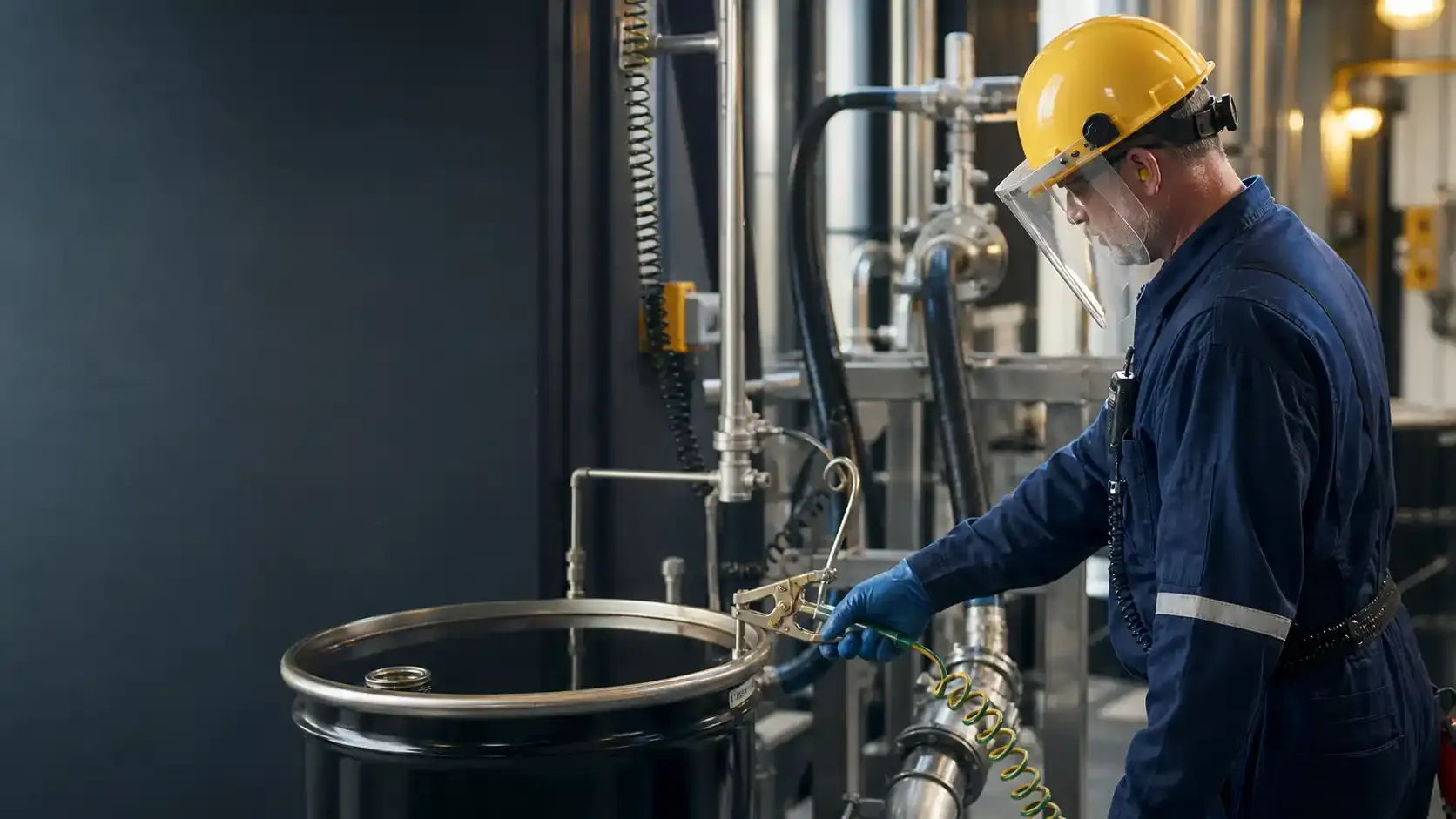
Static charge can build during ordinary transfer, filling and mixing work. Learn how bonding, grounding and operating discipline control this overlooked ignition source.
Static Electricity: Guarding Against the Invisible Spark
Static electricity is easy to ignore because it is often invisible, intermittent and familiar. In a flammable atmosphere, however, a small discharge can provide the ignition source for a fire or explosion. The hazard is most relevant when liquids, powders or gases are transferred, sprayed, filtered, mixed or poured.
Recognise the charging activities
Charge can be generated when a liquid moves through a hose or pipe, when a powder flows, when a filter separates material, when a belt moves or when a non-conductive container is handled. The risk increases where a flammable vapour, gas or dust cloud is present and a discharge can occur.
Start by mapping loading, decanting, sampling, blending, tanker transfer, drum filling and cleaning. Identify which materials are flammable or chargeable, where vapours can accumulate and which equipment may be electrically isolated.
Bonding and grounding do different jobs
Bonding connects conductive items so they remain at the same electrical potential. Grounding provides a path for charge to dissipate safely to earth. Both may be necessary during flammable-liquid transfer.
Do not assume a clamp is effective because it is present. Verify contact surfaces, cable condition, continuity and the connection sequence. Paint, corrosion, damaged teeth, insulated joints and improvised leads can defeat a seemingly correct arrangement.
Control the whole ignition system
Static control works alongside other barriers. Consider equipment suitability, ventilation, transfer rate, splash filling, inerting where justified, isolation of ignition sources, housekeeping and clear procedures. The UK HSE guidance on explosive atmospheres specifically identifies bonding conductors together and to earth as a control against static hazards.
For each task, define what must be checked before transfer starts, who verifies it and what condition stops the job. Include contractors and occasional tasks. The highest risk is often a one-off transfer performed outside the normal routine.
Test the scenario in a HAZOP
Use a HAZOP study or task-based review to ask: what if the bond is missing, the earth is ineffective, the hose is non-conductive, the product changes, the tank is overfilled, or ventilation is lost? Link the answer to protective actions, inspection and training.
Static risk also belongs in permit-to-work planning where line opening, solvent cleaning or temporary equipment could create a flammable atmosphere.
MMRisk helps facilities identify ignition sources, review safeguards and integrate static-control requirements into practical operating and maintenance systems. Contact our team for support.