
SANS 10089-1: Storage of Petroleum Products Explained
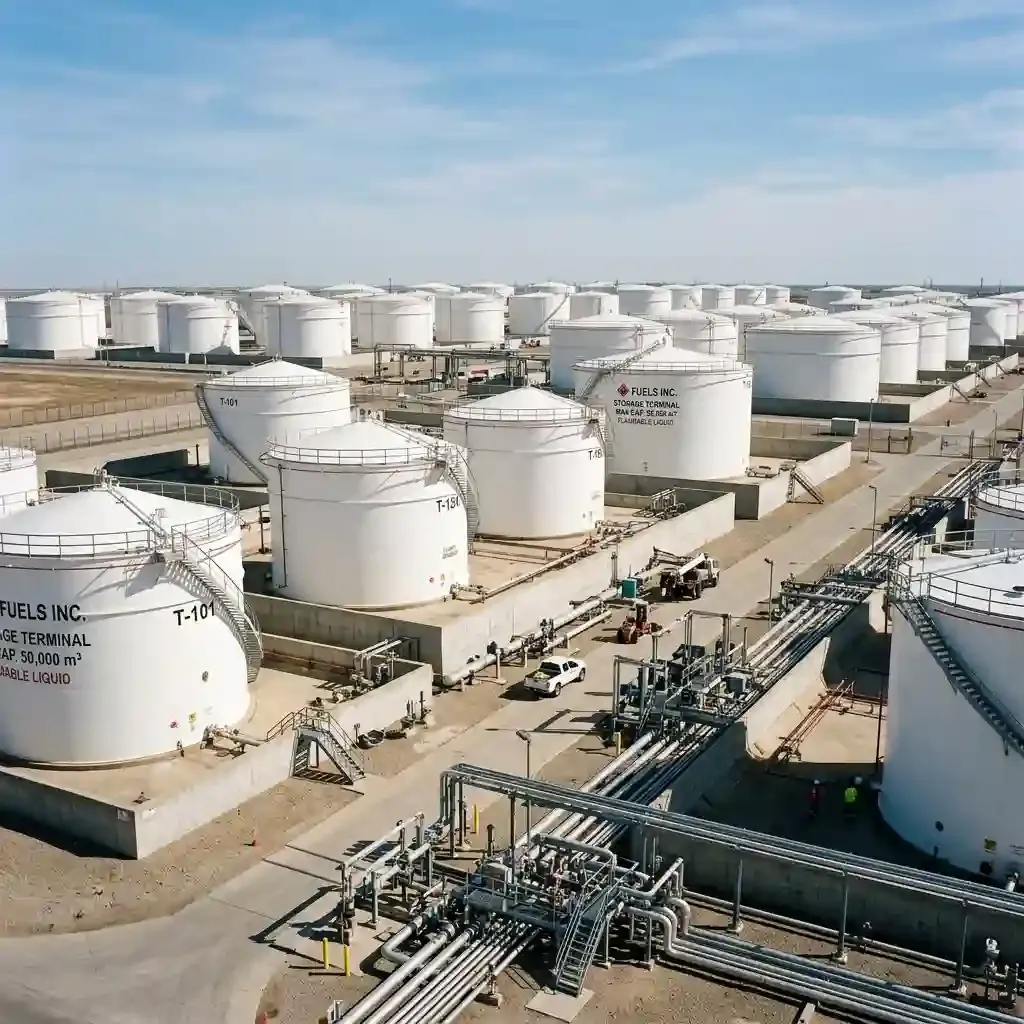
Storing bulk fuel requires more than just a big tank. SANS 10089-1 dictates strict design, spacing, and bunding requirements to prevent catastrophic pool fires.
SANS 10089-1: Storage of Petroleum Products Explained
In South Africa, the storage and distribution of bulk petroleum products—from diesel and petrol to aviation fuel—is governed by strict national standards. The cornerstone of these regulations for above-ground installations is SANS 10089-1.
Whether you are designing a new fuel depot, expanding a tank farm, or ensuring an existing facility meets the stringent MHI Regulations, compliance with SANS 10089-1 is non-negotiable.
Here is a breakdown of what the standard covers and why it is critical for process safety.
What is SANS 10089-1?
Part 1 of the SANS 10089 series specifically addresses the "Storage and distribution of petroleum products in above-ground bulk installations."
It provides the technical engineering specifications required to safely store highly flammable and combustible liquids. The primary goal of the standard is to prevent leaks, contain spills, and, most importantly, prevent a localized incident (like a tank overfill) from escalating into a massive, multi-tank pool fire.
Key Compliance Requirements
While the standard is comprehensive, process safety and MHI audits frequently focus on three critical areas:
1. Tank Spacing and Layout
SANS 10089-1 dictates the minimum safe distances between individual storage tanks, as well as the distance between tanks and the site boundary.
- The Reason: If one tank catches fire, adequate spacing ensures that the thermal radiation (heat flux) does not easily ignite an adjacent tank, preventing a domino effect.
- MHI Impact: When MMRisk conducts a Quantitative Risk Assessment (QRA), tank spacing directly influences the size of our modeled fire contours.
2. Bunding (Secondary Containment)
A "bund" is the containment wall built around a storage tank. SANS 10089-1 specifies exactly how these bunds must be designed.
- Capacity: The bund must be large enough to contain at least 110% of the volume of the largest tank within it, plus an allowance for fire-fighting foam and water.
- Integrity: The bund walls and floor must be impermeable to prevent fuel from contaminating the soil or groundwater.
- Separation: The standard dictates when intermediate bund walls are required to separate multiple tanks within a single main bund area.
3. Fire Protection Systems
Depending on the size of the tanks and the flash point of the fuel, the standard mandates specific active fire protection systems.
- This includes foam pourers, cooling water deluge systems, and the necessary water reservoir capacities required to fight a prolonged pool fire.
The Intersection of SANS 10089-1 and MHI
If your facility stores bulk petroleum, it is highly likely that you will trigger the threshold for an MHI screening.
During an MHI Risk Assessment, auditors use SANS 10089-1 as the baseline for "Good Engineering Practice." If your tank spacing is too tight or your bunding is inadequate according to SANS 10089-1, your modeled risk contours will be drastically larger, making it significantly harder to secure an MHI operating license.
Ensure Your Fuel Depot is Compliant
A gap in your SANS 10089-1 compliance is a major vulnerability in your safety profile and your legal standing.
At MMRisk, our process safety engineers specialize in evaluating bulk fuel installations. We can perform a detailed gap analysis against SANS 10089-1, model your fire and explosion scenarios, and guide you toward full compliance.
Contact MMRisk today to discuss your petroleum storage facility and ensure your safety barriers are up to code.
People Also Ask (FAQ)
What is a Major Hazard Installation in South Africa?
In South Africa, a Major Hazard Installation (MHI) is any industrial facility that stores, processes, or handles hazardous substances in quantities and conditions that, if a loss of containment occurs, could pose a significant risk to the health and safety of employees and the public outside the facility boundary.
Who enforces MHI regulations in South Africa?
The Department of Employment and Labour (DoEL) is the primary regulatory body enforcing MHI regulations under the Occupational Health and Safety Act, 1993.
What changed in the MHI Regulations 2022?
The 2022 update introduced a staged compliance approach, mandatory licensing for high-hazard establishments, stricter requirements for designating a competent Responsible Person, and mandatory alignment with SANS 1461 for risk assessments and SANS 1514 for emergency planning.
What is the penalty for MHI non-compliance?
Under the 2022 Regulations, failure to comply with MHI obligations is a criminal offence. Penalties can include severe fines ranging from ZAR 500,000 to ZAR 5,000,000, imprisonment for up to 24 months, and immediate operational prohibition by inspectors.
How often must an MHI risk assessment be renewed?
In South Africa, an MHI risk assessment must be comprehensively reviewed and resubmitted at least every 5 years. However, immediate updates are required if there is a significant change in the quantities of substances stored or if a process modification alters the site's overall risk profile.