
LPG Installations: Small Tanks, Big Risks
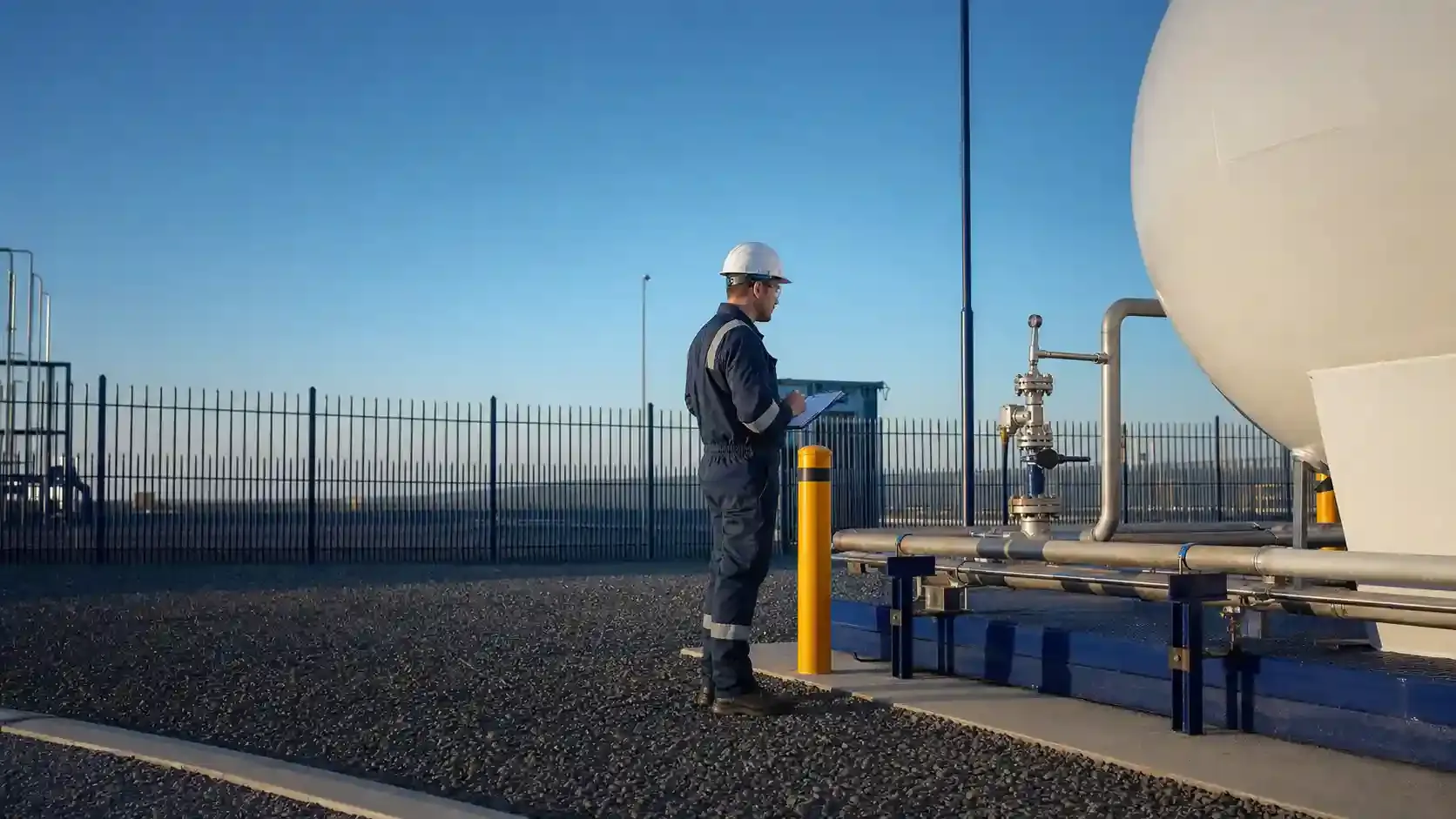
An LPG installation can create a major fire, explosion and public-risk scenario even when the storage inventory seems modest. Use this practical review guide to identify the real controls.
LPG Installations: Small Tanks, Big Risks
LPG is familiar enough to be underestimated. Cylinders and small bulk tanks are used by restaurants, factories, workshops, warehouses and fuel facilities every day. Yet a leak can travel, collect in low points, find an ignition source and escalate quickly. The question is not whether a tank appears small. It is whether a credible loss of containment could affect people, nearby equipment or the public.
Review the whole LPG system
Start beyond the vessel itself. A useful review covers delivery, tanker unloading, filling, storage, vapour and liquid pipework, regulators, hose connections, isolation, appliances, maintenance and emergency response. Map where gas could escape and where it could flow.
LPG vapour is heavier than air. Drains, pits, basements, enclosed loading areas and poorly ventilated enclosures deserve particular attention. A leak that disperses safely outdoors is a different scenario from one that enters a low-lying enclosed area.
Ask the right risk questions
During a hazard identification workshop, test common deviations:
- hose failure or incorrect connection during delivery;
- overfilling, loss of level indication or damaged valves;
- impact damage from vehicles or mobile plant;
- relief-valve discharge near an ignition source;
- corrosion, unsupported pipework or incompatible repairs;
- unauthorised cylinder storage or changes in customer demand;
- delayed isolation during a fire or gas alarm.
Each question should lead to a specific barrier and a named owner. “Operators are careful” is not a safeguard on its own.
Build reliable barriers
The control package normally includes suitable siting and separation, impact protection, protected isolation, competent installation and inspection, leak testing, emergency signage, restricted ignition sources, and procedures for delivery and cylinder exchange. Controls must match the actual layout and operating pattern. A tank protected from vehicle impact on one side can remain exposed during a different traffic route or after an expansion project.
Keep drawings and equipment information current. A change in tank size, inventory, pipe route, user, operating pressure or nearby building can alter the original risk basis and should enter management of change.
Plan for escalation, not only the first leak
The first release may not be the most damaging event. Consider jet fires, flash fires, vapour-cloud explosions and heat exposure to nearby cylinders or vessels. This is where consequence modelling and, where appropriate, a quantitative risk assessment can clarify which separation distances, emergency arrangements and site controls matter most.
Emergency plans should define alarm actions, isolation authority, assembly areas, fire-service information and communications with neighbouring occupiers. Do not ask responders to discover the inventory and isolation points during an incident.
Screen early for MHI relevance
Some LPG sites may need formal MHI screening or a more detailed assessment because the risk can extend beyond the boundary. The answer depends on inventory, layout, confinement, neighbouring land use and credible consequences. An MHI screening assessment provides a defensible starting point.
MMRisk supports LPG operators with screening, HAZOP, consequence analysis, emergency planning and MHI risk assessments. Contact us before expanding an installation, changing supply arrangements or accepting a layout that has never been risk-tested.
Related resources
- SANS 10089 petroleum storage explained
- Vapour cloud explosions: what operators need to know
- Emergency response compliance for MHI sites