
HAZOP Example Table: Complete Worked Example with Node Analysis
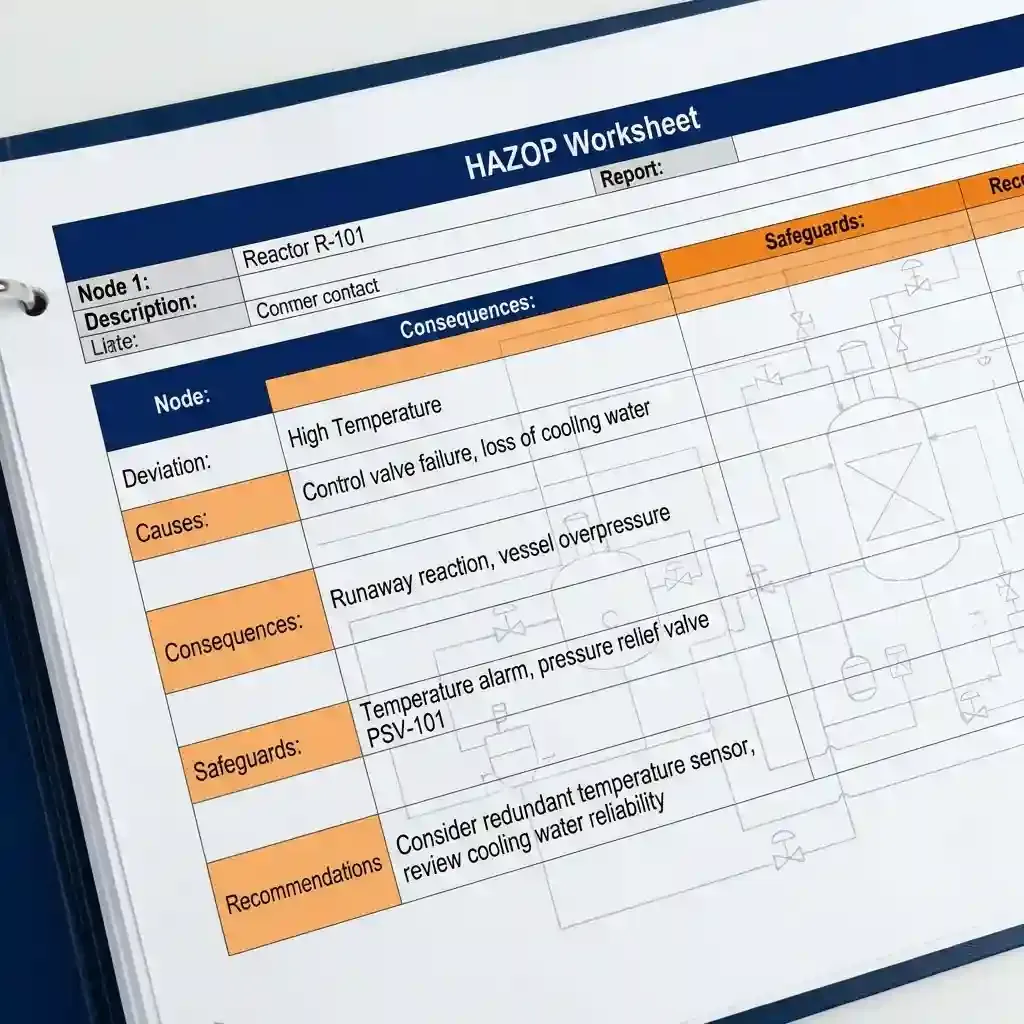
Looking for a real HAZOP table? Here's a complete worked example from a South African chemical reactor system—node-by-node analysis with deviations, causes, consequences, and safeguards. Perfect for learning or benchmarking your own studies.
HAZOP Example Table: Complete Worked Example
Quick Links: Reactor Feed System | Reactor System | Cooling System | Download Template
Learning HAZOP from theory is one thing. Seeing a real, complete example is another.
This article provides a fully worked HAZOP study example from a South African chemical manufacturing facility. We show the complete analysis for three interconnected nodes, including:
- Node definition and design intent
- Parameter selection
- Guide word application (all 10 standard guide words)
- Causes and consequences
- Existing safeguards
- Risk ranking
- Recommendations
Note: This example is sanitized for confidentiality but reflects real process safety considerations from our work at facilities like Sasol, Omnia, and AECI.
Process Overview
System Description
Process: Batch chemical reactor producing intermediate chemicals for further processing.
Components:
- Feed System: Raw material storage tanks, transfer pumps, control valves
- Reactor: 5000L jacketed batch reactor with agitator
- Cooling System: Cooling water circulation with chiller backup
Operating Conditions: - Feed temperature: 25°C ambient
- Reaction temperature: 80°C (controlled)
- Maximum allowable pressure: 5 barg
- Batch cycle: 4 hours
Hazardous Materials: - Reactant A: Flammable liquid (flash point 28°C)
- Reactant B: Corrosive acid
- Product: Non-hazardous intermediate
Example 1: Reactor Feed System {#example-1}
Node Definition
Node ID: N-001
Node Name: Reactant A Feed System
P&ID Reference: PID-101
Boundaries: From Tank T-101 outlet to Reactor R-101 inlet nozzle N1
Design Intent
| Parameter | Intended Value | Purpose |
|---|---|---|
| Flow | 500 L/hr | Deliver Reactant A to reactor at controlled rate |
| Temperature | Ambient (20-35°C) | Maintain material in stable liquid state |
| Composition | 99% Reactant A | Pure raw material for reaction |
| Pressure | 2 barg | Sufficient head to overcome system resistance |
HAZOP Worksheet - Node N-001
| Dev # | Parameter | Guide Word | Deviation | Causes | Consequences | Existing Safeguards | Risk (L/C/R) | Recommendations |
|---|---|---|---|---|---|---|---|---|
| N001-01 | Flow | NO | No flow of Reactant A to reactor | 1. Pump P-101 failure 2. Suction valve V-101 closed 3. Discharge valve V-102 closed 4. Line blockage 5. Tank T-101 empty |
1. Reaction stalled 2. Batch loss 3. Overheating if Reactant B continues (exothermic runaway) |
- Low flow alarm (FAL-101) at 350 L/hr - Tank levels displayed in control room (LI-101) - Batch interlock stops B addition if A flow stops |
3/4/H | REC-001: Upgrade low flow alarm to safety-rated low-low trip (FALL-101) that automatically stops reactor heating and Reactant B pump if A flow below 200 L/hr for >30 seconds |
| N001-02 | Flow | MORE | High flow of Reactant A | 1. Control valve FV-101 fails open 2. FIC-101 controller failure in manual/high output 3. Operator error in batch recipe |
1. Rapid reactor filling 2. Overflow through vent 3. Off-spec product 4. Possible overflow and fire risk |
- High level alarm (LAH-101) in reactor - High-high level trip (LAHH-101) stops feed pumps - Dedicated overflow line to catch tank |
2/3/M | REC-002: Add high flow alarm (FAH-101) at 650 L/hr to alert operators before high level is reached |
| N001-03 | Flow | LESS | Low flow of Reactant A | 1. Partial pump impeller wear 2. Partially blocked strainer 3. Leak in suction line 4. Low tank level |
1. Extended batch time 2. Off-spec product 3. Improper stoichiometry 4. Incomplete reaction |
- Flow indication (FI-101) displayed - Regular maintenance schedule |
3/2/L | No action required - existing controls adequate |
| N001-04 | Flow | REVERSE | Reverse flow back to tank | 1. Check valve NRV-101 failure 2. Reactor pressure exceeds feed pressure 3. Pump stops with reactor pressurized |
1. Contamination of Reactant A tank 2. Incorrect tank inventory 3. Possible reaction in tank |
- Non-return valve NRV-101 installed - Reactor pressure normally sub-atmospheric |
2/4/M | REC-003: Install dual check valves in series (second NRV at reactor inlet). Add pressure transmitter with alarm on Tank T-101 |
| N001-05 | Composition | AS WELL AS | Water contamination in Reactant A | 1. Rainwater ingress to tank 2. Contaminated delivery 3. Condensation in tank |
1. Violent exothermic reaction with water 2. Steam generation 3. Pressure surge in reactor 4. Possible vessel rupture |
- Tank sealed and vented through desiccant - Delivery sampling at receipt - Weekly moisture testing |
2/5/H | REC-004: Install inline moisture analyzer (AT-101) with interlock to close FV-101 if moisture >0.1%. Upgrade tank vent to nitrogen blanket |
| N001-06 | Composition | OTHER THAN | Wrong material delivered to tank (not Reactant A) | 1. Tanker delivers wrong chemical 2. Cross-connection with other tank 3. Mislabeled container |
1. Unknown reaction in reactor 2. Toxic gas generation 3. Fire or explosion 4. Personnel injury |
- Delivery verification procedure - Dedicated tank and hose connections - Sample testing before batch |
2/5/H | REC-005: Implement positive material identification system: dedicated camlock fittings for Reactant A only, computerized receipt validation against purchase order, mandatory lab confirmation before batch authorization |
| N001-07 | Temperature | MORE | High temperature in feed line | 1. Heat tracing malfunction 2. External fire 3. Prolonged summer conditions |
1. Increased vapor pressure 2. Possible pump cavitation 3. Flammable vapor release |
- No heat tracing installed - Feed line run indoors |
2/2/L | No action required - feed system is indoors and not heated |
| N001-08 | Pressure | MORE | High pressure in feed line | 1. Downstream blockage 2. Reactor over-pressurized 3. Control valve FV-101 fails closed |
1. Line rupture 2. Flammable spill 3. Personnel exposure |
- Pressure relief valve PSV-101 (set 4 barg) - Rated pressure of line: 10 barg |
2/3/M | REC-006: Review PSV-101 capacity calculation to ensure adequate relief for dead-head scenario. Add pressure indication to DCS |
Node N-001 Summary
Total Deviations Analyzed: 8
Level A (Critical) Recommendations: 2 (REC-004, REC-005)
Level B (Important) Recommendations: 3 (REC-001, REC-003, REC-006)
Level C (Enhancement) Recommendations: 1 (REC-002)
Example 2: Reactor System {#example-2}
Node Definition
Node ID: N-002
Node Name: Batch Reactor R-101
P&ID Reference: PID-102
Boundaries: Reactor vessel including jacket, agitator, vent, and internal instrumentation
Design Intent
| Parameter | Intended Value | Purpose |
|---|---|---|
| Temperature | 80°C (±2°C) | Optimal reaction temperature |
| Pressure | 0.5 barg | Slight positive pressure prevents air ingress |
| Level | 75-85% full | Adequate mixing volume without overfill |
| Agitation | 150 RPM | Ensure homogeneous mixing |
| Composition | Stoichiometric A:B ratio | Complete reaction without excess reactants |
HAZOP Worksheet - Node N-002
| Dev # | Parameter | Guide Word | Deviation | Causes | Consequences | Existing Safeguards | Risk (L/C/R) | Recommendations |
|---|---|---|---|---|---|---|---|---|
| N002-01 | Temperature | MORE | High reactor temperature (runaway) | 1. Cooling failure 2. Excessive Reactant B addition 3. Temperature controller failure 4. Loss of agitation |
1. Runaway reaction 2. Pressure increase 3. Relief valve discharge (toxic vapors) 4. Possible vessel rupture 5. Fatality risk in immediate area |
- High temperature alarm (TAH-102) at 85°C - High-high temperature trip (TAHH-102) at 90°C stops heating and B pump - Emergency cooling system (ECS) activated at 92°C - Pressure relief valve PSV-102 |
3/5/H | REC-007: Add independent Safety Instrumented System (SIS) for runaway protection: Independent temperature sensor + independent actuator for emergency quench addition. Target SIL 2 |
| N002-02 | Temperature | LESS | Low reactor temperature | 1. Heating failure 2. Excess cooling 3. Cold feed input 4. Temperature controller failure |
1. Slow reaction 2. Incomplete conversion 3. Batch extended 4. Off-spec product |
- Low temperature alarm (TAL-102) at 75°C - Batch timer alerts operator |
2/2/L | No action required |
| N002-03 | Pressure | MORE | High reactor pressure | 1. Relief valve blocked 2. Vent line blockage 3. Runaway reaction 4. Non-condensable gas accumulation |
1. Vessel overpressure 2. Relief valve lifting 3. Toxic vapor release 4. Potential vessel rupture |
- Pressure indicator (PI-102) - High pressure alarm (PAH-102) at 2 barg - Pressure relief valve PSV-102 (3.5 barg) |
3/5/H | REC-008: Install rupture disc in series with PSV-102 to prevent polymer buildup affecting PSV. Add high-high pressure trip to initiate emergency vent to scrubber |
| N002-04 | Pressure | LESS / NO | Low pressure / Vacuum in reactor | 1. Vacuum pulled during cooling 2. Vent valve fails open 3. Condenser over-cools |
1. Air ingress 2. Flammable vapor/air mixture in headspace 3. Potential internal explosion during startup |
- Vacuum breaker VB-102 on reactor - Nitrogen purge system |
2/4/M | REC-009: Increase nitrogen blanket pressure setpoint from 0.3 to 0.5 barg. Add oxygen analyzer on reactor vent with interlock to inject nitrogen if O2 >1% |
| N002-05 | Level | MORE | High level in reactor | 1. Excess feed 2. Level transmitter failure 3. Drain valve blocked |
1. Overflow through vent 2. Flammable spill 3. Product loss 4. Fire risk |
- High level alarm (LAH-102) at 85% - High-high trip (LAHH-102) at 90% stops feed |
2/3/M | REC-010: Install overflow line to dedicated catch tank with level detection |
| N002-06 | Level | LESS | Low level in reactor | 1. Excessive drainage 2. Feed failure 3. Level transmitter failure |
1. Poor mixing 2. Agitator damage (runs dry) 3. Concentrated reaction zones (hot spots) |
- Low level alarm (LAL-102) at 50% - Operator monitoring |
3/3/M | REC-011: Add agitator current monitoring with alarm - abnormal current indicates level or mixing issues |
| N002-07 | Agitation | NO | No agitation | 1. Motor failure 2. Shaft coupling break 3. Power failure |
1. Loss of mixing 2. Hot spots form 3. Localized runaway reaction 4. Stratification of reactants |
- Agitator motor running lamp - Current monitoring (historical trend only) |
3/4/H | REC-012: Install positive agitator rotation confirmation (vibration sensor on gearbox). Interlock: If agitation confirmed lost, stop Reactant B addition and initiate controlled cooldown |
| N002-08 | Composition | PART OF | Reactant B missing/insufficient | 1. B pump failure 2. B tank empty 3. Valve closed |
1. Incomplete reaction 2. High concentration of unreacted A 3. Off-spec product 4. Extended processing |
- B flow indication - Batch recipe calculation |
3/2/L | No action required - operational issue with economic not safety consequence |
| N002-09 | Time | EARLY | Reactant B added before A | 1. Batch sequence error 2. PLC failure 3. Operator override |
1. Concentrated B reacts violently when A added 2. Exothermic kick 3. Pressure surge |
- Batch management system sequence - Operator training |
2/4/M | REC-013: Implement PLC-enforced batch sequence that prevents B pump start until A level reaches minimum batch charge (confirmed by level and flow totalization) |
Node N-002 Summary
Total Deviations Analyzed: 9
Level A (Critical) Recommendations: 3 (REC-007, REC-008, REC-012)
Level B (Important) Recommendations: 4 (REC-009, REC-010, REC-011, REC-013)
Level C (Enhancement) Recommendations: 0
Example 3: Cooling Water System {#example-3}
Node Definition
Node ID: N-003
Node Name: Reactor Cooling Water System
P&ID Reference: PID-103
Boundaries: From cooling water header to reactor jacket and return to cooling tower
Design Intent
| Parameter | Intended Value | Purpose |
|---|---|---|
| Flow | 50 m³/hr | Sufficient heat removal for controlled reaction |
| Temperature In | 25°C | Cool enough for effective heat transfer |
| Temperature Out | 40°C | Indicates proper heat removal |
| Pressure | 3 barg | Sufficient head through jacket |
HAZOP Worksheet - Node N-003
| Dev # | Parameter | Guide Word | Deviation | Causes | Consequences | Existing Safeguards | Risk (L/C/R) | Recommendations |
|---|---|---|---|---|---|---|---|---|
| N003-01 | Flow | NO | No cooling water flow | 1. Pump failure 2. Valves closed 3. Major leak 4. Power failure |
1. Loss of reactor temperature control 2. Temperature rise 3. Runaway reaction (see N002-01) |
- Low flow alarm (FAL-103) - Emergency cooling system (independent chiller) |
3/5/H | REC-014: See REC-007. Ensure emergency cooling system startup is automated (currently manual initiation) |
| N003-02 | Flow | LESS | Low cooling water flow | 1. Partial blockage 2. Fouled jacket 3. Pump impeller wear |
1. Reduced heat removal 2. Temperature rises slowly 3. Operator intervention required |
- Flow indication and trending - Temperature differential monitoring |
3/3/M | REC-015: Implement predictive maintenance for cooling water pumps based on flow/differential pressure trending |
| N003-03 | Temperature | MORE | High cooling water inlet temperature | 1. Cooling tower issue 2. High ambient temperature 3. Chiller failure |
1. Reduced cooling capacity 2. Reactor temperature control difficulty 3. Potential runaway if sustained |
- Cooling water inlet temperature indication - High temperature alarm on cooling water header |
3/4/H | REC-016: Install trim cooler (plate heat exchanger with chilled water) to cap cooling water temperature at 30°C during summer peaks |
| N003-04 | Pressure | LESS | Low cooling water pressure | 1. Pump issues 2. Header pressure drop 3. Major leak elsewhere in system |
1. Reduced jacket flow 2. Inadequate cooling |
- Pressure indication - Low pressure alarm |
2/3/M | No action required - low pressure results in low flow which triggers FAL-103 |
| N003-05 | Composition | AS WELL AS | Contamination in cooling water | 1. Process leak into jacket (jacket breach) 2. Cooling tower contamination |
1. Corrosion of jacket 2. Environmental issue if process leaks out 3. Possible contamination of site cooling water system |
- Visual inspection during turnaround - Cooling water at sub-process pressure |
2/4/M | REC-017: Install cooling water return pH and conductivity monitoring with alarms. Any deviation indicates jacket breach requiring immediate shutdown and inspection |
Node N-003 Summary
Total Deviations Analyzed: 5
Level A (Critical) Recommendations: 2 (REC-014, REC-016)
Level B (Important) Recommendations: 2 (REC-015, REC-017)
Complete Recommendations Summary
Critical Actions (Address Immediately)
| Rec # | Description | Node | Risk Rank |
|---|---|---|---|
| REC-004 | Install inline moisture analyzer with interlock | N-001 | High |
| REC-005 | Positive material identification system | N-001 | High |
| REC-007 | Independent SIS for runaway protection (SIL 2) | N-002 | High |
| REC-008 | Rupture disc + high-high pressure trip | N-002 | High |
| REC-012 | Agitator confirmation interlock | N-002 | High |
| REC-014 | Automate emergency cooling system startup | N-003 | High |
| REC-016 | Trim cooler for summer cooling capacity | N-003 | High |
Important Actions (Address Within 6 Months)
| Rec # | Description | Node | Risk Rank |
|---|---|---|---|
| REC-001 | Upgrade to safety-rated low-low flow trip | N-001 | Med-High |
| REC-003 | Dual check valves + tank pressure monitoring | N-001 | Medium |
| REC-006 | Review PSV capacity for dead-head scenario | N-001 | Medium |
| REC-009 | Increase N2 blanket + O2 analyzer interlock | N-002 | Medium |
| REC-010 | Overflow line to catch tank | N-002 | Medium |
| REC-011 | Agitator current monitoring | N-002 | Medium |
| REC-013 | PLC-enforced batch sequence | N-002 | Medium |
| REC-015 | Predictive maintenance for CW pumps | N-003 | Medium |
| REC-017 | CW return monitoring for jacket breach | N-003 | Medium |
Download HAZOP Templates {#download}
Use our professionally designed templates for your own studies:
Free Templates Available Now
📊 HAZOP Worksheet Template
- Pre-formatted deviation table
- Risk ranking matrix included
- Action tracking section
- Print-ready landscape format
📋 HAZOP Guide Words Reference Card - All 10 guide words with examples
- Facilitator prompts
- Parameter matrices
- Common mistakes to avoid
✅ MHI Compliance Checklist 2026 - 15-point compliance tracker
- Key deadline timeline
- Progress tracking fields
Download Now
How to save as PDF:
- Click a link below to open the template
- Press Ctrl+P (or Cmd+P on Mac)
- Select "Save as PDF" as your printer
- Click Save
Download Links
➡️ HAZOP Worksheet Template - Print in landscape orientation
➡️ HAZOP Guide Words Reference Card - Print for all team members
➡️ MHI Compliance Checklist 2026 - Track your compliance status
Need all resources? Visit our Free Resources Page for all downloadable templates.
How This Supports Your SANS 1461 Compliance
This example demonstrates the systematic approach required by SANS 1461:2018 for MHI risk assessments:
✅ Systematic hazard identification – Every node, every parameter, every guide word
✅ Cause analysis – Multiple credible causes for each deviation
✅ Consequence analysis – Tracing to worst credible outcome
✅ Safeguard evaluation – Documenting existing protection
✅ Risk ranking – Prioritizing for action
✅ Actionable recommendations – Specific, implementable improvements
When the Department of Labour audits your facility, they want to see this level of rigor in your Safety Report (Annexure D).
Related Resources
HAZOP Methodology
- Ultimate HAZOP Study Guide for South African Industries
- HAZOP Guide Words: Complete Reference Card
- 7 Critical HAZOP Guide Words: Stop Missing Hazards
Study Planning
- How to Prepare Your Team for a HAZOP Study
- HAZOP Team Composition: Who Needs to Be in the Room
- Choosing the Right HAZOP Facilitator
After the HAZOP
- What Happens After Your HAZOP Study?
- HAZOP Study Report Contents: What Must Be Included
- HAZOP Study Cost in South Africa
Risk Assessment
- Fault Tree vs Event Tree Analysis
- Qualitative vs Quantitative Risk Assessment
- When is Quantitative Risk Assessment Required?
MMRisk (CI MHI 0013): Professional HAZOP facilitation with documented, auditable, SANS 1461-compliant studies across South Africa. Contact us to schedule your study.